

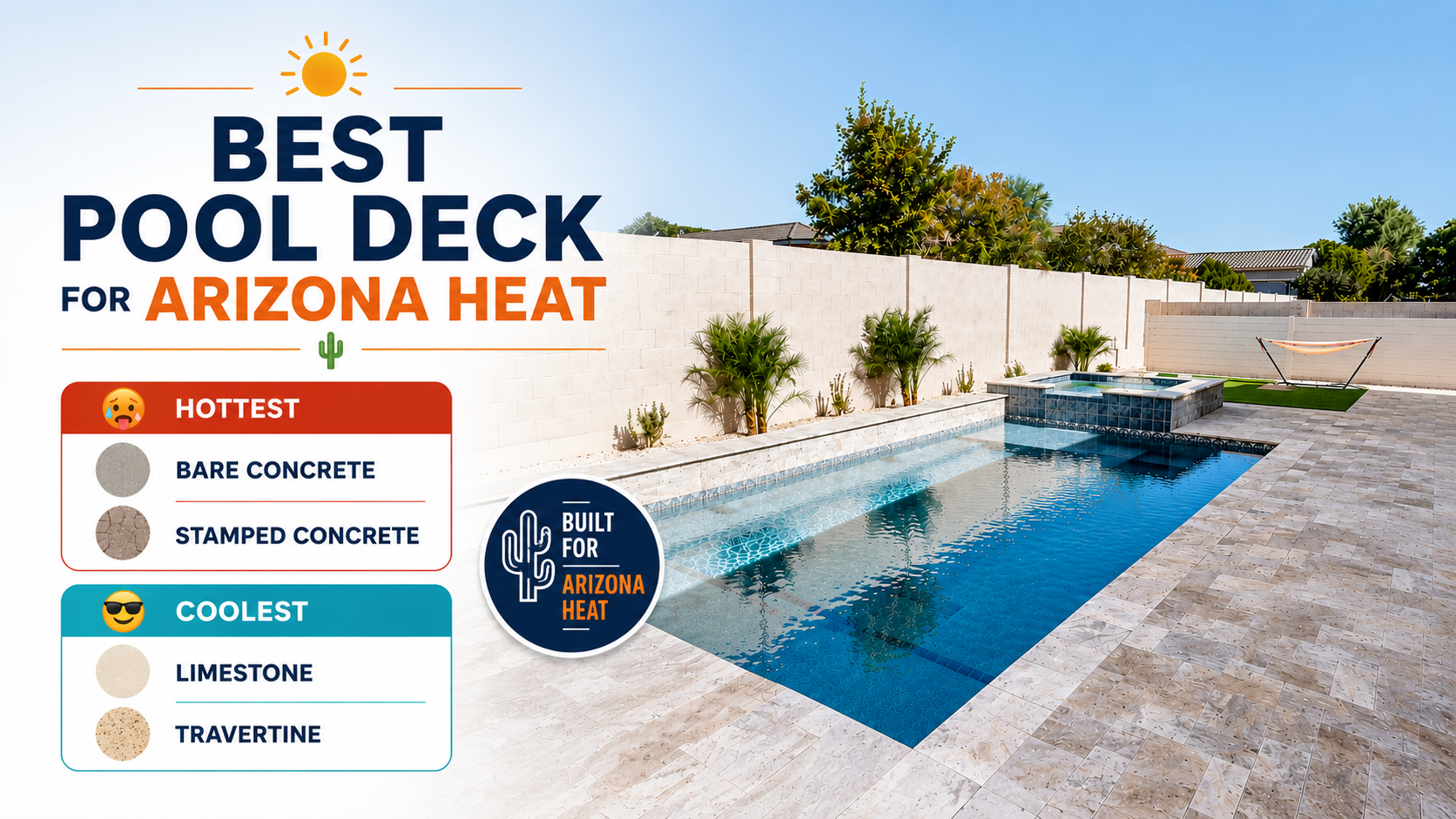
You're getting quotes for a new pool or thinking about replacing your existing deck. Does it really matter if you pick travertine or cool deck paint? Especially, if everything just get scorching hot in an Arizona summer anyway.
The material you choose affects how hot your deck gets at 2pm in July. Also, how much maintenance you're doing five years from now, and how much you'll spend over the life of the pool.
At Shasta, we've been building and remodeling Arizona pools since 1966. We've seen which materials hold up through the desert heat. This article highlights the best decking option. We share how they perform in Arizona conditions, and who each material is and isn't right for.
Table of Contents
- Does It Matter What Pool Deck Material You Choose in Arizona?
- What are the Arizona Pool Deck Options?
- How Each Pool Deck Material Handles Arizona Heat?
- What Pool Deck Material Lasts in Arizona?
- Which Pool Deck Material Is Right for Your Arizona Pool?
Does It Matter What Pool Deck Material You Choose in Arizona?
Most homeowners assume all pool decks get equally hot in the summer. Yes, everything gets hot in Arizona. Although, there's a real difference between a surface that hits 130°F on a July afternoon and another at 110°F. The material and even the color all play a role in how much heat a deck absorbs.
What smart homeowners figure out before they chose a pool deck material?
Heat absorption and dissipation aren't the same thing. A surface can get hot and cool down fast. Another decking material gets hot and stays hot. Texture changes temperature. A sandblasted or tumbled finish reflects more heat than a smooth or polished surface.
Everything Gets Hot though Your Feet can Tell
"In Arizona, everything gets hot — concrete paver, natural stone, all of it. The difference is in the small things that are actually perceptible under your feet. And one of the simplest ways to cool any deck down fast is to just spray it with water before you use it." — Derin Uras, Natural Stone Expert from ANS MERMER USA

What are the Arizona Pool Deck Options?
There are multiple options for pool deck materials. Each has their own pros and cons. The best one is based on each person's individual preferences.
Acrylic Deck Coating — Xcel Surfaces
What most people mean when they say "cool deck. You pour a concrete slab, then apply a textured acrylic coating over the top. Shasta uses Xcel Surfaces. The Phoenix-based manufacturer engineering concrete coating systems are a 100% acrylic top coat. The bond coat penetrates the concrete and the top coat adds color and grip.
-
Most affordable decking option available
-
Adds slip resistance and some heat reduction
-
Good upgrade path for existing concrete decks
-
Wide range of colors and finishes
Concrete and Stamped Concrete
Bare concrete is still common on Arizona pool decks. Stamped concrete adds a decorative pattern pressed into the slab before it cures. Holds heat more than any other material on this list.
-
Lower upfront cost
-
Wide range of stamped patterns available
-
Durable slab underneath
Travertine
The most popular natural stone choice for Arizona pool decks. Formed through natural springs, travertine has small pits and pores that add natural slip resistance and faster heat dissipation. Travertine absorbs heat, but it dissipates it quicker than something like a concrete paver or a porcelain paver.
-
Dissipates heat faster than concrete
-
Natural slip resistance
-
Works with both classic and modern pool designs
-
Best all-around balance of heat performance and durability
Limestone
The limestones coming into Arizona for pool deck applications are lighter in color and more uniform than travertine. Limestone is actually cooler on the feet than travertine. It absorbs heat and dissipates it far quicker.
What it does well:
-
Coolest natural stone option underfoot
-
Modern, uniform aesthetic
-
Good durability when properly sealed
Marble
Marble is growing fast in Arizona pool design. It's the most durable natural stone option on this list. Marble is dense, so it doesn't absorb as much liquids. However, it retains a lot more heat. When it gets hot, it's hotter than travertine and limestone.
-
Most durable and stain-resistant natural stone
-
Lowest ongoing maintenance
-
Best fit for modern and contemporary pool designs
-
Textured finishes (sandblasted, leathered) reduce heat significantly
Travertine, Marble, or Limestone
"When it comes to picking a stone for the outdoor pool deck — between travertine, marble, and limestone — it's hard to rank them because it really depends on what a homeowner wants. If a homeowner wants something super modern and durable, marble is going to be the right choice. If somebody wants kind of the least amount of headache and good durability, travertine will be the right fit. If someone's okay with the maintenance required for a limestone and wants that modern, cool touch to the stone, then limestone would be the right application. But in general, travertine is going to be a good starting point because there are a lot of different color options." — Derin Uras, ANS MERMER USA

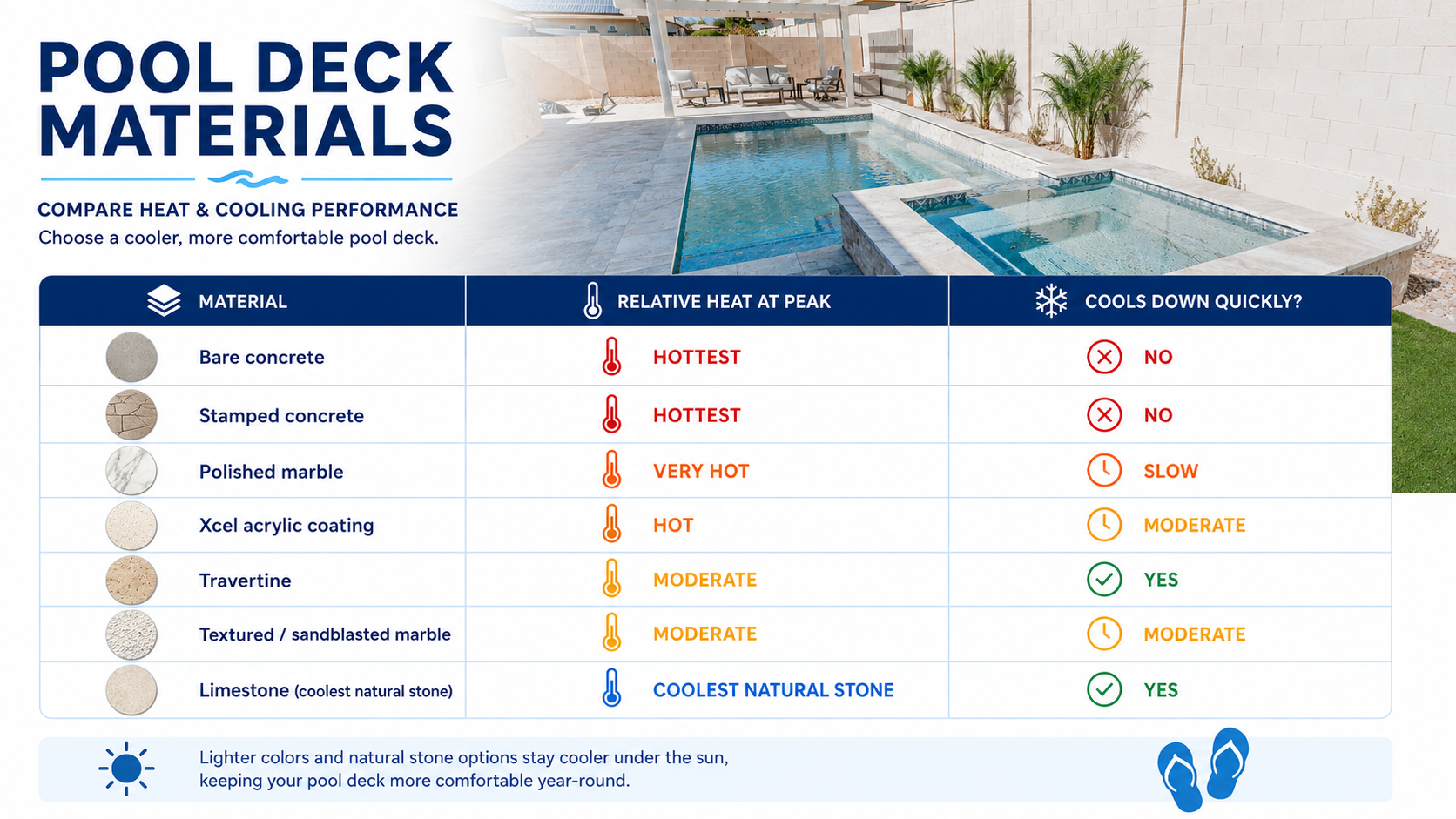
How Each Pool Deck Material Handles Arizona Heat?
|
Material |
Relative Heat at Peak |
Cools Down Quickly? |
|---|---|---|
|
Bare concrete |
Hottest |
No |
|
Stamped concrete |
Hottest |
No |
|
Polished marble |
Very hot |
Slow |
|
Xcel acrylic coating |
Hot |
Moderate |
|
Travertine |
Moderate |
Yes |
|
Textured / sandblasted marble |
Moderate |
Moderate |
|
Limestone |
Coolest natural stone |
Yes |
What Pool Deck Material Lasts in Arizona?
Arizona's combination of extreme UV and expansive soils is harder on pool decks than almost anywhere else in the country.
How Acrylic Coatings Hold Up
A properly applied Xcel Surfaces acrylic coating on a well-prepped concrete slab holds up well. In Arizona's UV exposure, expect to recoat every 5 to 7 years in high-traffic areas. Some homeowners stretch it to 8 or 9 years.
What affects how long it lasts:
-
Application quality at install
-
Lighter colors tend to show wear less
-
Hosing it down regularly and keeping it clean

Why Bare Concrete and Stamped Concrete Struggle Long-Term in Arizona
Arizona decks go from 110°F surface temperatures in summer to near-freezing overnight temps in winter. Concrete expands and contracts with every cycle. Over years, that movement creates stress fractures and hairline cracks.
In Arizona's expansive soils, a normal deck — they would just pour the concrete right on top of the pool shell. What happens is the decking wants to lift up over the pool shell, and you get this unsightly gap between the bottom of the deck and the top of the pool tile.
Natural Stone Longevity
Natural stones (travertine, limestone, marble) outlasts every other option on this lis. Properly installed and sealed travertine or marble can look good for 20 to 30 years in Arizona conditions.
Recommended to Seal the Natural Stones
"Across the industry, stone is recommended to be sealed. But there are a lot of vendors who say you don't need it. One reason is a sense of planned obsolescence — if the material deteriorates after a certain amount of years, you're going to have to come back and buy it again. The other reason is the sealers back in the day used to create a wet look that changed the experience of the stone. But nowadays the chemicals have changed. They impregnate the stone — go into the top layer, fill in the pores, don't allow as much water absorption, and they don't change the color. So now it's 100% recommended. And I think that's been missing in the industry." — Derin Uras, ANS MERMER USA
What happens without sealing in Arizona:
-
Chlorine and pool water absorb into porous stone repeatedly
-
Staining from iron and organic material
-
Surface erosion on limestone and travertine accelerates
Which Pool Deck Material Is Right for Your Arizona Pool?
If you want the best all-around natural stone for Arizona choose travertine. It's the most popular choice for a reason. Good heat performance, natural slip resistance, works with both classic and contemporary designs, and holds up for decades when it's sealed properly.
Limestone is the coolest natural stone underfoot. The trade-off is it needs more maintenance than travertine and it needs to be sealed. Marble is the right call for homeowners who want something that holds up beautifully for 25 to 30 years.
If you have an existing concrete deck and want to upgrade it checkout Xcel acrylic coating. Significant improvement in appearance and heat performance over bare concrete.
If a homeowner wants something super modern and durable, marble is going to be the right choice. If somebody wants kind of the least amount of headache and good durability, travertine will be the right fit. If someone's okay with the maintenance required for a limestone and wants that modern, cool touch to the stone, then limestone would be the right application. But in general, travertine is going to be a good starting point because there are a lot of different color options.

Resources
Ansmemer.com Tools and Resources
Xcelsurfaces.com Literature and Training
Topics:
