

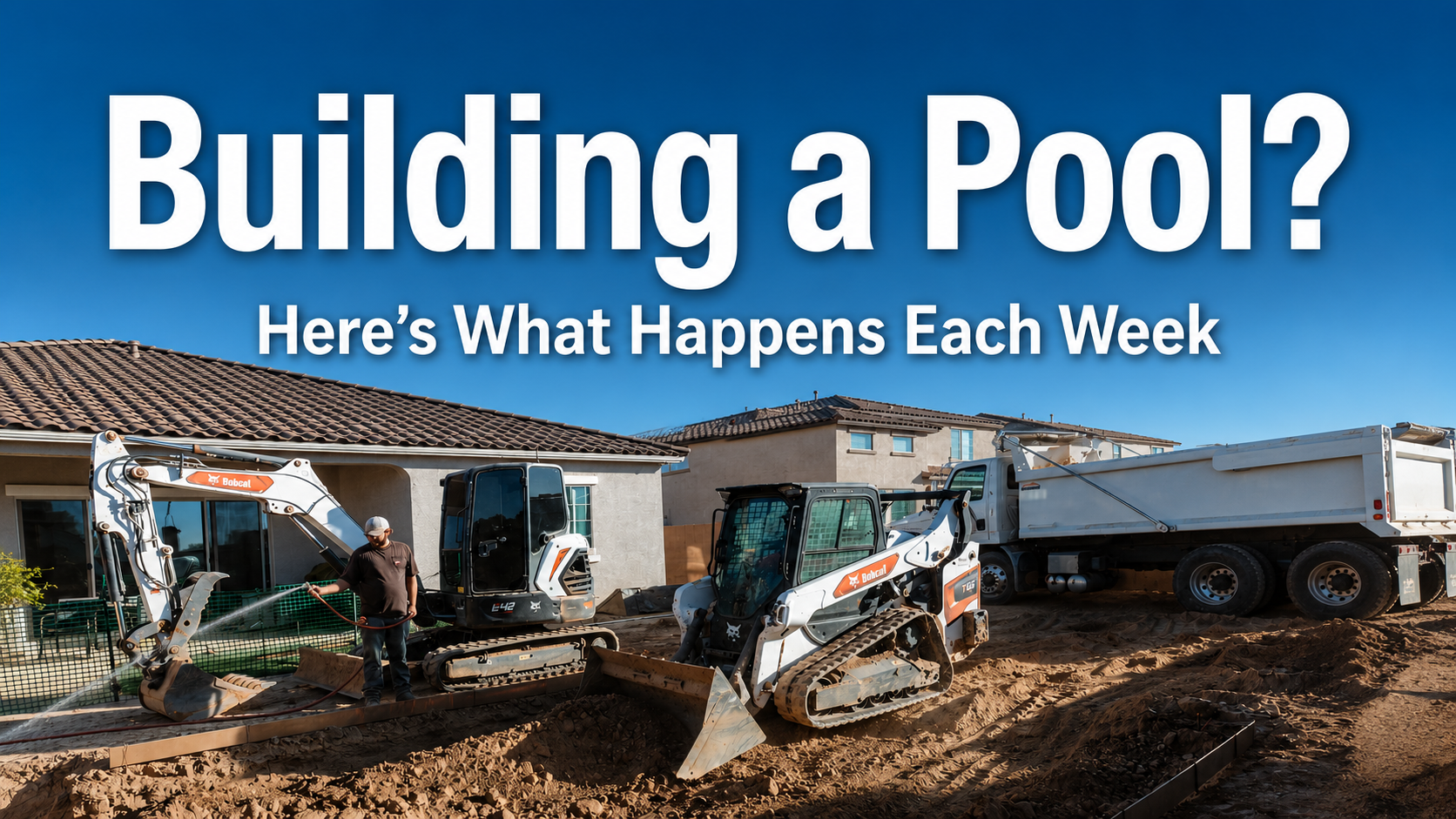
You've decided you want a pool. Now you're trying to figure out what the next few months of your life are actually going to look like.
Shasta Pools has built over 130,000 pool projects since 1966. We've seen every soil condition and every phase of construction in the Phoenix metro. Our commitment to service and transparency has helped us earn 2025 #1 ranking in Arizona by Pool & Spa News.
This article provides the Arizona pool construction timeline week by week. We share the process from the day you sign your contract to the day you get in the water. Lastly, you'll understand what's happening at each phase and why some phases take longer than you may think.
By the end, you'll have a clear picture of what you're committing to — and you'll be able to walk into your builder conversation with the right questions already in hand.
Table of Contents
- How Long Does It Take to Build a Pool in Arizona from Start to Finish?
- What Happens Before Construction Starts? (Weeks 1–6)
- Week-by-Week: The Arizona Shotcrete Pool Construction Timeline
- When Can You Be Swimming?
How Long Does It Take to Build a Pool in Arizona from Start to Finish?
Most Arizona shotcrete pools take 3 to 6 months from the day you sign your contract to the day you're swimming. Once construction actually begins — meaning the excavator is in your backyard — you're looking at 2 to 2.5 months to get water in the pool, depending on complexity.
A new Fiberglass pool construction timeline contains 2-3 weeks once excavation starts.
-
Arizona Pool Timeline: 3 to 6 months
-
Permits and pre-construction: 4 to 8 weeks before excavation begins
-
Excavation to water (shotcrete): 2 to 2.5 months
-
Excavation to water (fiberglass): 2 to 3 weeks
-
First swim after interior finish: approximately 1 week after plaster and water chemistry is balanced
Many pool builders claim "8 to 12 weeks." This timeline starts at excavation. Many new pool owners confuse this timeframe from the moment they sign the contract. The permitting and pre-construction phase adds 4 to 8 weeks. In some Phoenix-area cities, permits move fast and in others the process is slow.
Design - Permits - Scheduling - Construction
"The process could take, you know, after excavation is completed, it could take two and a half, three, three and a half months, depending on the complexity of a concrete pool. Or it could take a matter of weeks if it's a fiberglass pool. We do have a project management system that gives the customer basically a customer portal. We require all the phases, all the crews doing the work to submit photos when a phase is completed." — Skip Ast III, Director of Sales Shasta Pools

|
Week |
Phase |
What's Happening |
What You'll See |
|---|---|---|---|
|
1–2 |
Permits & Pre-Construction |
Design finalized, permit submitted, HOA review begins, build scheduled |
Nothing in your backyard yet |
|
3–4 |
Layout & Excavation |
Pool shape staked, excavator digs the hole |
A hole that matches your pool shape |
|
4–5 |
Plumbing & Steel |
Pipes trenched and run, rebar cage built inside the hole |
Pipes, trenches, steel cage taking shape |
|
5–6 |
Electrical |
Wiring run for pumps, lighting, automation, sanitation |
Conduit runs — not visually dramatic |
|
6–7 |
Shotcrete |
Concrete shot through hose onto steel cage, troweled smooth |
Your pool has a shell for the first time |
|
7–10 |
Shotcrete Curing |
Shell hardening and gaining structural strength |
Nothing — this is the build working correctly |
|
8–10 |
Decking & Hardscape |
Pool surround, patio, outdoor living elements installed |
Backyard starts looking like a backyard again |
|
9–11 |
Tile & Coping |
Waterline tile and pool edge cap installed |
Pool develops its finished look |
|
10–12 |
Interior Finish |
PebbleTec or aggregate finish applied to shell |
Pool interior goes from raw concrete to finished surface |
|
11–13 |
Startup & Orientation |
Pool filled, equipment activated, water chemistry balanced, homeowner walkthrough |
Water going in — your pool coming to life |
What Happens Before Construction Starts? (Weeks 1–6)
After you sign your contract, your builder submits for permits. In the Phoenix metro, permit timelines vary by city. Straightforward residential pool projects can move through city review in as little as a few business days in some municipalities. In others — or in communities where HOA architectural review runs alongside the city permit — you're looking at 4 to 8 weeks before anyone can legally break ground. Complex projects or luxury HOA communities can push that to 8 to 12 weeks.
What's happening during this time:
-
Final pool design is locked and engineering plans are drawn
-
City permit application is submitted
-
HOA architectural review runs separately — and simultaneously
-
Site evaluation confirms access, drainage, and any soil concerns
-
Your build is scheduled in the construction queue
Your city permit and your HOA approval are two completely separate processes. One doesn't substitute for the other. Your HOA takes often longer than the city. We have found this regularly in planned communities in Scottsdale and Gilbert.
Also, this phase we finalize your equipment selections, confirm your decking and tile choices, and sort out any fence or gate access your builder will need. Getting those decisions locked early prevents delays once construction begins.
Permits and Construction
"The pool — you have your taxes, you have your permits in there — and then all of a sudden it's like, oh, you've got to run electrical a little bit further. Oh, you have a little bit of demo here. Construction has them too, and they're all different depending on what you're being dealt with in your backyard." — James Arrowood, Pool Designer Shasta Pools

Week-by-Week: The Arizona Shotcrete Pool Construction Timeline
Once permits are approved and your build is scheduled, construction moves through a clear sequence of phases. Here is what each one looks like, how long it takes, and what you should expect to see — or not see — during that time.
Weeks 1–2: Layout, Site Prep, and Excavation
This is the week most homeowners have been waiting for. The crew stakes out the pool shape in your backyard exactly as it was designed. Then the excavator comes in — usually a backhoe or Bobcat — and starts digging.
Excavation itself typically takes one to three days for a standard pool. Don't be surprised if it goes faster than you expect. The hole in your backyard at the end of week one will be the most dramatic visible progress you see for a while. I think it's worth mentioning that for a lot of homeowners, this is the moment the whole thing finally feels real.
Arizona soil conditions matter here. Caliche — the hard, calcium-rich soil layer common across the Phoenix metro — can slow excavation and sometimes add cost if it's deeper or more extensive than expected. A builder who knows the Valley well will recognize it quickly and handle it without making it your problem to solve.
What you'll see: A hole in your backyard that matches your pool shape. Equipment may come and go quickly.
What you might worry about: It went too fast. It didn't. Excavation is supposed to be fast.
Weeks 2–3: Plumbing and Steel
Plumbing comes first. Crews trench the equipment area out to the pool shell. Additionally, they run pipes that will handle circulation and any water features. Next, the steel crew arrives and builds the rebar cage inside the excavated hole. Rebar creates the structural skeleton that gives your pool shell its strength and durability. Shasta uses steel reinforcement twice as thick as the industry standard.
Both phases require city inspections before the next phase can proceed. The rough plumbing inspection verifies pipe sizing and bonding connections. The pre-pour inspection checks rebar spacing and coverage before shotcrete is applied.
Don't worry if nobody is here every day. That's normal. Scheduling inspections takes time.

Week 3–4: Electrical
The electricians come in and run wiring for everything. This phase moves quickly when everything is pre-planned. However, it slows down if your electrical panel needs upgrading.
Week 4–5: Shotcrete
This is the phase that makes your pool a pool.
A cement truck pulls up, concrete is mixed at the truck and fed through a large hose, and the crew shoots it directly onto the steel cage — walls first, then floor. Troweling follows to smooth the surface. By the end of the day, your pool has a shell.
Shotcrete day is one of the most satisfying days of the build. The hole in the ground becomes an actual pool shape. However — and this is important — what comes next is the phase most homeowners don't account for.
What you'll see: A concrete shell that looks like a finished pool. It is not finished.
What comes next: Curing. And curing takes time.

Weeks 5–8: Shotcrete Curing
This is the longest invisible phase of the build — and the one that generates the most "why is nothing happening?" calls to builders.
Shotcrete needs time to cure before the next phases can begin. In Arizona's heat, curing typically takes 3 to 4 weeks minimum.
The pool looks done from the outside. It isn't. The concrete is still hardening and gaining structural strength. Rushing this phase by moving to tile, decking, or interior finish too early creates problems that show up years later. A builder who protects this curing window is doing you a favor, even when it doesn't feel like it.
What you'll see: Nothing. The shell sits. Crews may water it periodically.
What you might worry about: The build has stalled. It hasn't. This wait is the build working correctly.
Weeks 6–9: Decking and Hardscape
While the shell is curing, or shortly after, the decking crew comes in.
Decking is everything around the perimeter of your pool — the surface where your furniture sits, your family walks, your outdoor space lives. The most common materials in Arizona are concrete with an acrylic coating, travertine, or pavers like Belgard or other stone products. Each has different lead times, installation requirements, and performance characteristics in desert heat.
If you've added outdoor living elements — a fire pit, outdoor kitchen, covered patio — this phase is when that work happens too.
What you'll see: Your backyard starts to look like a backyard again, not a construction site.
Weeks 8–10: Tile and Coping
Tile runs around the inside perimeter of the pool at the waterline. Its main job is protecting the interior finish from exposure as water levels rise and fall — but it's also one of the most visible aesthetic decisions in your pool.
Coping is the cap material that runs along the pool's top edge, where the pool meets the deck. Both tile and coping require careful installation and enough cured shell to adhere to properly.
What you'll see: The pool starts developing its finished look. Colors and materials you chose in the design phase are now visible in the actual pool.
Weeks 9–11: Interior Finish
The interior finish — often a PebbleTec or similar aggregate product — is applied to the shell in a process similar to the original shotcrete phase. This is the waterproof barrier between the concrete shell and your pool water. It also determines the color and texture of your pool's interior.
The finish choice affects what color your water appears. A lighter finish creates a crisp blue. Darker finishes produce deeper, richer tones. This is the last major decision that gets locked in during construction, and it's one of the most visually impactful.
What you'll see: The pool interior goes from raw concrete to its finished surface in a single day.
Weeks 11–12: Startup, Fill, and Orientation
The pool is filled. Equipment is activated. Water chemistry is balanced. And then — probably the best moment of the whole process — your builder walks you through everything.
At Shasta, every new pool comes with three months of Shasta Pool Care service. The startup team makes sure the water chemistry is exactly where it needs to be from day one, and you get a full orientation on your equipment — what it does, how to use it, and what to watch for.
Depending on the municipality, Shasta's superintendent manages six to seven inspections through the build. The final one is done with you, the homeowner, so any questions or concerns get addressed before the job is considered complete.
Superintendent Inspections
"Depending on the municipality, we will have six to seven inspections that the superintendent does. And the final inspection is with the homeowner." — Skip Ast, Director of Sales, Shasta Pools
What you'll see: Water going in. Equipment running. Your pool coming to life.
When you can swim: Once the interior finish has cured and water chemistry is balanced — typically about a week after plaster. Your startup team will give you the exact date.

When Can You Be Swimming?
So, how long does it take to build a pool in Arizona? For a shotcrete pool, plan for 3 to 6 months from contract to first swim. The construction itself runs 2 to 2.5 months once permits clear.
Realistic expectations support homeowners create the best experiences. The permit phase does takes time. The shell will sit for a few weeks during curing.
When do I get in the pool?
For most Arizona homeowners building a shotcrete pool, the answer is between 3 and 6 months from today. If you want to be swimming by a specific date, the smartest thing you can do is start the conversation now.

Topics:
