

You’re about to make a $40,000 to $100,00 decision that will impact your finances. Yet most homeowners spend more time comparing smart phones than choosing a pool builder.
It’s easy to get swept up in pool shapes, finishes, and features. The success of your pool has far less to do with how it looks on paper and far more to do with who builds it. Permits, engineering, access, warranties, subcontractors, and construction standards rarely show up in Starting Base Pool Packages.
Problems don’t show up immediately. They appear as missed timelines, unexpected costs, finger-pointing between subcontractors, or permit issues. Even worse projects stall or never get finished at all. Experience alone isn’t enough if you don’t know what questions actually reveal it.
The five questions below are designed to uncover what most estimates don’t explain. What many homeowners don’t think to ask until it’s too late. They help you identify red flags early and understand what’s truly included in your price. Afterwards, choose a builder who can confidently deliver your project and not just sell it.
These aren’t “nice-to-know” questions. They’re the difference between protecting your swimming pool investment and hoping everything works out.
Table of Contents
-
Can You Provide References or a Portfolio of Completed Pools?
- Why These Five Questions Matter More Than the Price
Is Your Pool Builder Licensed and Insured?
Licensing and insurance are requirements for any legitimate builder. If a builder isn’t properly licensed and insured, the risk transfers directly to you. In Arizona, a licensed pool builder must meet state requirements for experience, bonding, and accountability. That license gives you legal recourse if something goes wrong.
As Jordan Isaac, New Pool Sales Designer at Shasta, explains:
“People assume every pool builder is licensed. There are a bunch of contractors operate out of their truck without proper licensing or coverage. When something goes wrong—and it does—the homeowner is the one exposed. That’s where people lose tens of thousands of dollars.”
Before you sign anything, verify:
- The builder contractor’s license is active
- The license specifically covers pool construction, not just general contracting
- They carry current general liability and workers’ compensation insurance

Why licensing and insurance matter for your pool builder
Licensed pool contractors have proven their expertise by passing examinations covering essential topics like pool design, safety regulations, building codes, and construction methods. This verification process ensures your contractor understands local regulations and can build pools that meet safety standards. Furthermore, licensed contractors are typically screened for prior criminal history, providing additional peace of mind.
Here's what happens without proper licensing:
- Your pool might not meet local building codes, potentially resulting in hefty fines or even demolition costs
- Most manufacturers void warranties on equipment installed by unlicensed contractors, leaving you responsible for costly repairs
- You have no legal recourse through state licensing boards if problems arise
Insurance protects you from financial disaster. Consider this scenario: a technician accidentally damages your patio during pool construction. With a properly insured company, you're protected from unexpected costs.
Three types of insurance your pool builder must carry:
General Liability Insurance - Covers accidents causing damage to your property during construction
Workers' Compensation - Ensures you won't be liable if workers are injured on your property
Property Damage Insurance - Covers the cost of repairs if the contractor damages other parts of your property
Without these protections, you could be personally liable for injuries, property damage, or even workers' medical expenses. Many homeowners' insurance policies explicitly state they won't cover damages caused by work performed by unlicensed contractors.
What to look for in pool builder credentials
Requirements vary significantly by location. A certification valid in Florida might not meet requirements in California. Many states require pool contractors to pass competency examinations demonstrating knowledge of industry standards.
Start with these baseline requirements: • State-specific pool construction license • Current general liability insurance • Active workers' compensation coverage • Proof of financial responsibility (bonds or credit checks in many states)
Look for additional certifications that signal expertise:
- CPO (Certified Pool Operator) - Verifies understanding of chemical and physical properties of pool maintenance
- CPSI (Certified Pool/Spa Inspector) - Demonstrates competence in pool inspection and safety guidelines
Financial stability matters. In many states, contractors must provide proof through credit reports or bonds. For instance, in Florida, applicants need credit reports containing FICO-derived credit scores that show local, state, and federal records have been searched.
The credential check reveals more than qualifications. It shows whether the contractor is serious about running a legitimate business.

How to verify your pool builder's documents
Don't take anyone's word for their credentials. Verification takes 15 minutes and can save you years of problems.
Step 1: Get physical copies of all licenses and insurance certificates
Step 2: Verify licensing directly with the state • Contact your state's licensing board or use their online verification tools
Step 3: Confirm insurance coverage Don't just look at the paperwork. Contact the insurance company directly to confirm the policy is current and has adequate coverage limits. Confirm both general liability and workers' compensation policies are active.
Step 4: Check their problem resolution history Read online reviews focusing specifically on how the company handles problems. Rather than just looking at star ratings, pay attention to those middle-tier (3-4 star) reviews where customers explain how issues were resolved. Ask potential builders to explain specific negative reviews and how they addressed those situations.
Step 5: Verify financial responsibility Some states require contractors to demonstrate financial responsibility through bonds or credit checks. Ask for proof that they've met these requirements, which helps ensure they can complete your project even if unexpected costs arise.
Legitimate pool builders welcome these verification requests. Their transparency about credentials often indicates their professionalism and commitment to proper construction practices.
The contractors who resist credential verification are the ones you need to avoid.

How Much Experience Do You Have with Pools Like Mine?
Most pool builders will confidently say they’ve built “hundreds of pools.” What they often don’t clarify is what kind of pools. Pool construction isn’t a single skill set. It’s a combination of engineering, hydraulics, steel placement, soil conditions, access logistics, and long-term planning.
As Jordan Isaac, New Pool Sales Designer at Shasta Pools, explains:
“Experience only matters if it matches the project. Engineering changes when you go deeper than five feet. Circulation changes with different cleaning systems. Access alone can completely change how a pool is built. Those aren’t things you learn on your first few jobs.”
When you ask this question, listen for specifics:
- How many pools similar to yours have they built recently?
- Can they explain the engineering or construction differences confidently?
- Do they reference real challenges they’ve solved?
Why Experience Matters More Than You Think
Pool construction isn't like other home improvement projects. You can't just figure it out as you go.
Experienced builders bring specific advantages:
- Deep understanding of local soil conditions and water tables
- Knowledge of the most efficient construction techniques
- Ability to resolve unexpected challenges quickly • Familiarity with local building codes and permit requirements • Strong relationships with trusted suppliers and subcontractors
The difference shows up in their processes. Experienced builders typically have "clearly defined sales, planning, and execution processes" that make your project smoother and more predictable.

Match Their Experience to Your Pool Type
Not every pool builder has experience with every type of pool or feature. This is where you need to get specific about their background.
Ask about their experience with:
Pool Materials and Construction Types Concrete, fiberglass, vinyl liner - each requires different skills and equipment.
Special Features Infinity edges, beach entries, tanning ledges, swim-up bars.
Technical Systems Advanced automation, saltwater systems, in-floor cleaning systems.
Challenging Installations Hillside pools, complex drainage requirements, limited access situations.
Here's the key question: "Since some styles – like infinity pools – require special installation expertise, make sure to also ask how much experience the company has with the specific style you're looking for".
A builder might have installed hundreds of standard rectangular pools but have limited experience with the complex engineering required for a negative-edge design.
Watch for red flags. If a contractor "dodges the question" about their experience with your specific pool type, this is considered a significant warning sign. Even quiet builders should be able to provide at least one relevant example.
How to Actually Verify Their Claims
Don't just take their word for it. Get proof.
Start with the Numbers Ask how many pools they've installed since being in business and how many they completed in the past year. These numbers tell you about both their longevity and current activity level.
Get Real References Request contact information for previous clients with pools similar to your planned project. Call at least 10 references and ask specific questions about their experience:
- "If you could do it over, would you use this pool builder again?" • "What did you enjoy about the experience?"
- "What was least enjoyable?" • "How did the pool builder handle challenges when they arose?"
The quality of references matters. Industry professionals consider it a red flag if a builder provides fewer than half of their customers as references. That suggests they have a significant number of unsatisfied clients.
Review Their Portfolio A reputable pool builder should eagerly share photographs of completed projects similar to yours. Look at finish quality, design complexity, and consistency across projects.
Read Between the Lines in Reviews Skip the five-star reviews and focus on the middle-tier (3-4 star) reviews. These often provide more balanced feedback about how the company handles challenges. Ask potential builders to explain specific negative reviews and how they addressed those situations.
The builder's response to your questions about past work can be as telling as the answers themselves. Confident, transparent builders who take pride in their work will welcome the opportunity to showcase their experience and address concerns openly.
Can You Provide References or a Portfolio of Completed Pools?
Here’s something most homeowners don’t realize. A builder who hesitates to show their work is answering your question without saying a word. Reputable pool builders are proud of what they’ve built. A strong portfolio and real references showcase evidence that a contractor can consistently deliver on their promises.
As Jordan Isaac, New Pool Sales Designer at Shasta Pools, puts it:
“Anyone can post photos online. What matters is whether a builder can show real projects, explain how they handled challenges, and connect you with homeowners who were satisfied after the pool was finished—not just when the contract was signed.”
References do more than confirm that a pool was completed. They reveal:
- How the builder handled delays or unexpected issues
- Whether problems were resolved or ignored
- What the experience was like after construction ended
It’s also important to look beyond highlight photos. Ask:
- Are the projects similar in size, style, or complexity to yours?
- Can the builder explain why certain design or construction choices were made?
- Will they talk openly about issues they’ve fixed—not just flawless outcomes?
Jordan often encourages homeowners to go a step further:
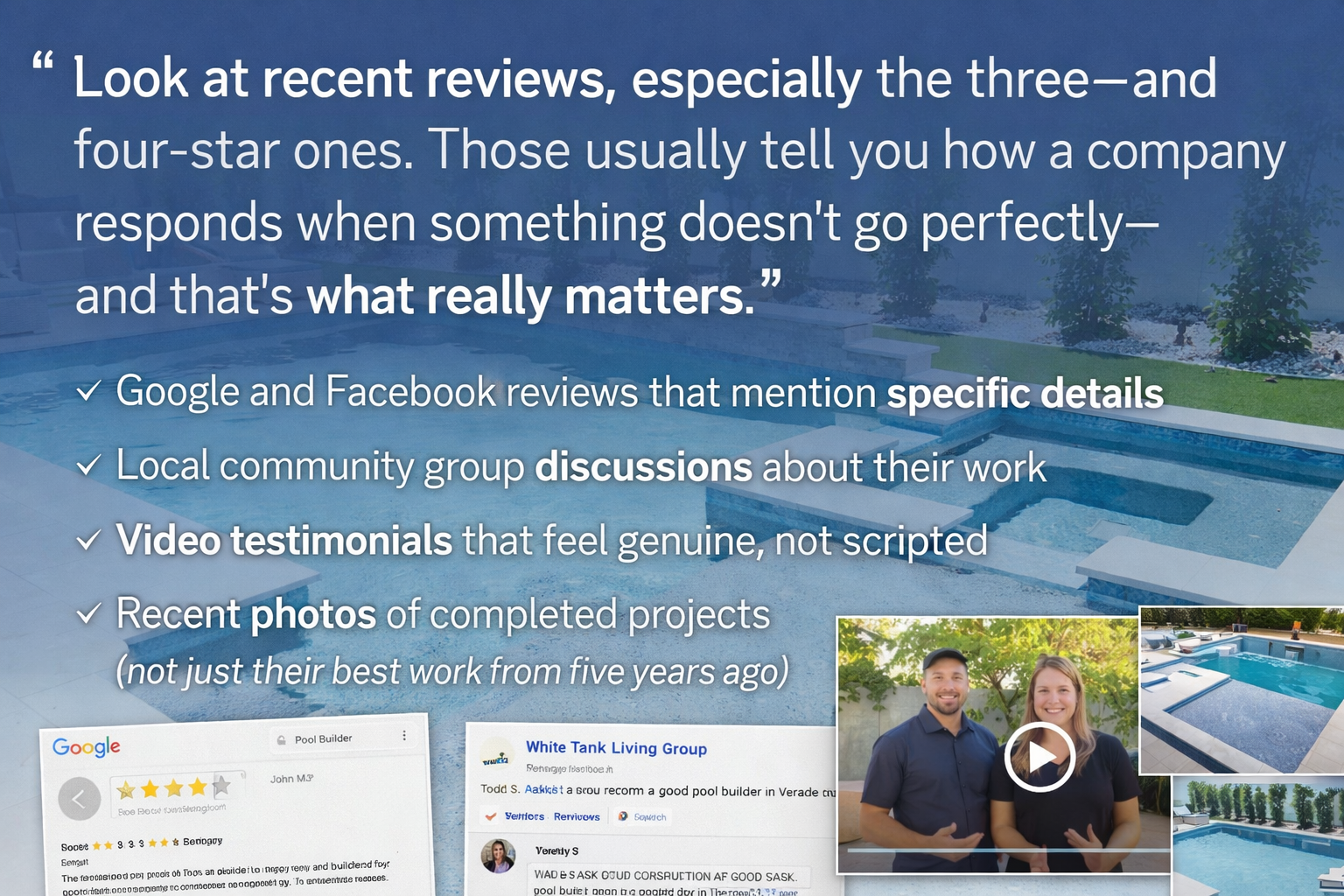
“Look at recent reviews, especially the three- and four-star ones. Those usually tell you how a company responds when something doesn’t go perfectly and that’s what really matters.”
What References Actually Tell You
References aren't just about getting a list of happy customers. They're about understanding how a builder handles problems when things go sideways—and they always go sideways at some point.
A trustworthy pool builder should have a history of happy clients. But what you really want to know is how they handle the unhappy moments. The excavation that hits unexpected rock. The permit delay that pushes back your timeline. The equipment that arrives damaged.
The quantity of references matters more than you might think. A reputable pool builder should offer you a substantial list—ideally "at least 50 names, preferably a hundred or more". If they can only give you five or six names, ask yourself why. Industry professionals consider it a significant warning sign if a builder provides "less than half of their customers as references".
Here's what you're looking for beyond the traditional reference list:
- Google and Facebook reviews that mention specific details
- Local community group discussions about their work
- Video testimonials that feel genuine, not scripted
- Recent photos of completed projects (not just their best work from five years ago)
Pay attention to the middle-tier reviews (3-4 stars) rather than just the perfect ones. These often tell you more about how the company actually operates when challenges arise.
The Right Questions to Ask References
Don't waste your time asking "Were you satisfied?" You'll get a polite "yes" that tells you nothing.
Instead, ask questions that reveal the real experience:
"If you could do it over, would you use this pool builder again?" This cuts through the politeness and gets to their true feelings.
"What was the most frustrating part of the process?" Every project has frustrating moments. You want to know what they were and how the builder handled them.
"How did they communicate when problems came up?" This reveals their problem-solving approach and transparency.
"What surprised you about working with them?" Sometimes the most telling insights come from unexpected aspects of the experience.
"What would you do differently if you were starting over?" This gives you insights they gained that could help your project.
Call at least 10 references to establish patterns. Listen for hesitations, qualified praise, or subtle warnings they might not state directly.
If possible, arrange to see one of their completed pools in person. Photos can hide flaws that become obvious when you're standing next to the actual work.

How to Evaluate Their Portfolio
A professional portfolio should show you range, consistency, and attention to detail across multiple projects. What you don't want to see is the same basic rectangular pool repeated dozens of times, or only their absolute best work from years past.
Look for these elements:
Quality consistency across different budgets and styles. A good builder maintains standards whether they're building a $40,000 basic pool or a $150,000 custom design.
Details that matter. Check the smoothness of pool surfaces, how well the pool integrates with surrounding landscaping, and the execution of special features like waterfalls or lighting.
Diversity in projects. If you want an infinity pool, make sure they've built infinity pools, not just basic shapes.
If a contractor can't show you what they've built, or worse, offers vague references—it's a strong sign they may lack the experience necessary to handle your project. You shouldn't have to guess what their work looks like.
Watch out for builders who only show you "a few low-quality images or generic stock photos, you have no way of knowing whether they can actually deliver the quality they promise".
What Good References and Portfolios Reveal
When a builder confidently shares extensive references and detailed portfolios, they're telling you several things: they're proud of their work, they maintain good customer relationships, and they have nothing to hide about their process or results.
Poor references or reluctant portfolio sharing usually indicates problems you don't want to inherit: inconsistent quality, communication issues, or customers who wouldn't recommend them.
Your job is to separate the builders who consistently deliver from those who occasionally get lucky. References and portfolios give you the evidence you need to make that distinction.
What Is Included in the Pool Estimate or Quote?
A pool estimate isn’t just a price. It’s a definition of responsibility. On the surface, two pool quotes may look similar. In reality, many low bids appear attractive because major components are quietly excluded. Those missing items don’t go away. They show up later as change orders, cash-only expenses, or uncomfortable conversations halfway through construction.
As Jordan Isaac, New Pool Sales Designer at Shasta Pools, explains:
“The biggest pricing issues I see aren’t about people changing their minds—it’s about things they assumed were included. Access, permits, taxes, electrical runs, soil conditions… if it’s not clearly spelled out, that’s where projects blow up.”
A clear, professional estimate should specifically outline:
- Permits and municipal fees
- Taxes
- Excavation and access assumptions
- Engineering and structural specifications
- Equipment models and system types
Ask What's NOT Included in Your Quote
The most revealing question you can ask a pool builder is: "Can you walk me through what's not included in this quote?". This approach often uncovers more red flags than asking what is included. Many builders present competitive quotes by omitting significant costs or providing lowball estimates for certain items.
When a contractor starts listing exclusions, pay attention to their tone. Legitimate builders will explain these items clearly because they want you to understand the full scope. Sketchy contractors will downplay the importance or give vague answers about "standard industry practices."
Focus on these key components that vary dramatically between quotes:
Pool Equipment Packages: Ask specific questions about what you're getting. Single-speed or variable-speed pumps? What type and size filter? Are heaters, saltwater systems, or automation included? Some builders offer basic timers while others include full smartphone control systems—the difference could mean thousands in cost.
Electrical Work: Pool electrical requirements are complex and costly. Watch for phrases like "electric by others" or allowances (like "Electrical hookup – $2000 allowance"). These indicate you'll need to hire an electrician separately, and the actual cost often exceeds the allowance.
Utilities and Connections: Check if gas line installation for heaters is included. Many builders exclude this work unless explicitly noted.
Every important detail should appear in the quote, and anything omitted should be clearly outlined so you understand your responsibilities.
Hidden Costs That Can Double Your Budget
Even well-intentioned builders sometimes leave out costs that can add thousands to your project's final price. Here are the most common ones:
Excavation and Soil Conditions: Standard quotes assume normal digging conditions. If your yard slopes or has challenging soil, you might need retaining walls or special equipment. Ask your builder about soil evaluation and potential excavation challenges. Rocky or caliche soil can add significant costs that aren't included in standard quotes.
Permits and Regulatory Requirements: Building permits typically cost between $450 and $1800. Your builder should know local regulations and include these costs upfront.
Property Damage and Repair: Heavy equipment will damage your landscaping, sprinkler systems, and possibly your driveway. Budget for repairs or replacement of grass, flower beds, and hardscaping.
Automatic Covers: Starting around $12,000, these safety features are often excluded from base quotes despite their growing popularity.
Finishing Touches: Many homeowners spend an additional $25,000–$50,000 on patios, fencing, and electrical work beyond the basic pool installation. Pool decking alone ranges from $500 to $20,000 depending on materials and design.
Ask potential builders: "Have past customers ever paid more than their original contract price? If so, why?" Their answer will tell you how they handle unexpected costs.
Payment Schedules That Protect You
A fair payment structure ensures neither you nor the builder gets ahead of the other. This prevents situations where you've paid most of the money but the work isn't complete, or where the builder has done most of the work but hasn't been paid.
A typical schedule includes:
- Initial deposit (covers permits and planning)
- First major payment after excavation (25%)
- Second payment after shotcrete/gunite application (25%)
- Third payment after tile and coping installation (25%)
- Final payment upon completion
Red flags in payment schedules:
- Requiring 100% payment before the pool is filled with water
- Large upfront payments before any work begins
- Cash-only payment requirements
- Vague milestone descriptions
Reputable builders have separate draw schedules based on actual cash flow needs. Automatic covers might require 50% down because that's what the manufacturer requires, while concrete work might need only 10% initially.
Your contract should clearly explain:
- Total project cost and payment breakdown
- How change orders affect price and documentation process
- Acceptable payment methods
- Who receives payments
- Requirements for lender-financed projects
Be wary of anyone requesting cash payments, especially if they claim it enables discounts. Legitimate contractors can accept checks and credit cards. Cash requests often indicate tax avoidance or unlicensed operations.
What Is the Timeline for Pool Completion?
One of the easiest ways to spot a risky pool builder is by how quickly they promise to finish your project. Most homeowners don’t need the fastest pool built. Yet many contractors quote aggressive timelines to win bids. However, they know full well those numbers won’t hold once construction begins.
Most inground pool projects take 8 to 12 weeks from excavation to completion. This assumes normal conditions and standard designs. Highly customized pools with deeper engineering can take several months. It’s the cost of doing things correctly.
As Jordan Isaac, New Pool Sales Designer at Shasta Pools, explains:
“The builders who promise the shortest timelines are usually the ones juggling too many jobs. When something unexpected happens—and it always does—your project gets pushed while they chase the next sale.”
Reliable builders focus less on selling a perfect timeline and more on explaining:
- How many projects they run concurrently
- Which phases are weather- or permit-dependent
- Where delays are most likely—and how they’re handled
- How communication works if the schedule shifts
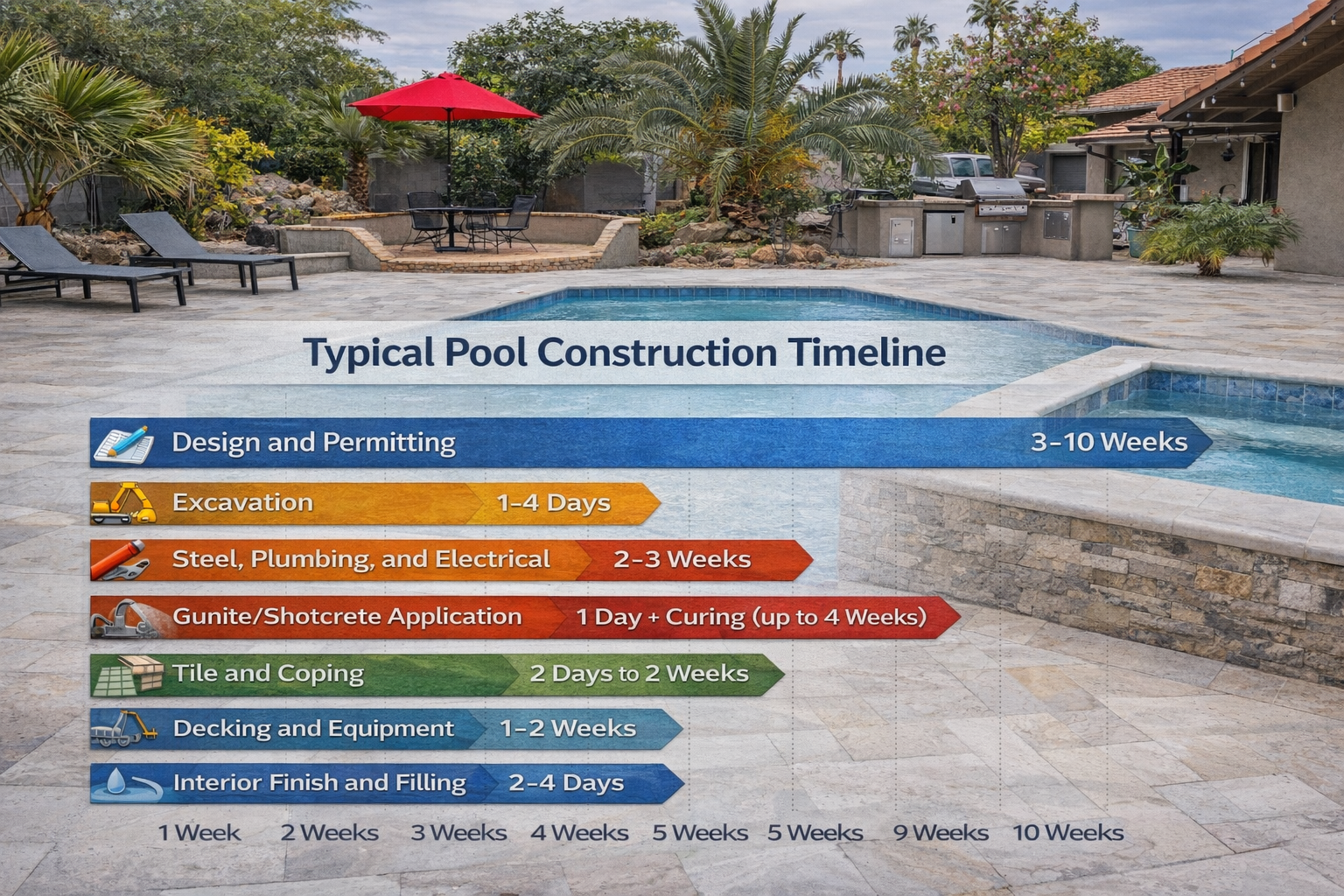
Typical Phases of a Pool Construction Project
Pool construction follows a specific sequence. Each phase depends on the previous one being completed correctly.
Design and Permitting (3-10 weeks): This happens before any digging starts. Design typically takes 1-4 weeks, but permit approvals can require 2-6 weeks depending on your location and project complexity. Your builder should handle permits, but delays here are common and often underestimated.
Excavation (1-4 days): The actual digging happens fast, usually completed in 1-4 days for standard pools. Weather can delay this phase significantly.
Steel, Plumbing, and Electrical (2-3 weeks): Workers install steel reinforcement, plumbing pipes and drains, plus initial wiring for equipment and lighting. This is where many projects hit their first major delays because coordination between trades is required.
Gunite/Shotcrete Application (1 day + curing time): The concrete application happens in one day, but then requires 3-4 weeks of curing before work can continue. Nothing can be rushed during this phase.
Tile and Coping (2 days to 2 weeks): Timeline varies significantly based on materials and design complexity. Custom tile work takes longer than standard options.
Decking and Equipment (1-2 weeks): Decking installation and equipment connections. This phase often reveals whether your electrical planning was adequate.
Interior Finish and Filling (2-4 days): The final finish gets applied, then your pool is filled and chemical balancing begins.
What Causes Pool Construction Delays
Even well-planned projects face delays. The difference is how your builder handles them.
Weather: Rain or extreme temperatures stop work, especially during excavation and gunite phases. One rainy day can delay work for several more days.
Supply Chain Issues: Shortages of pumps, filters, or specialty finishes impact timelines. Good builders order materials early and have backup suppliers.
Labor Shortages: Skilled trades are often booked, particularly during peak season.
Soil Problems: Rocky soil, high water tables, or underground utilities require additional excavation and specialized equipment.
Design Changes: Modifications after construction starts create delays that ripple through the entire timeline.
Permit and Inspection Delays: Permits might take 15-30 days in some areas, plus inspection scheduling affects each phase.
How Professional Builders Communicate About Timelines
Good builders communicate proactively. Poor builders make you chase them for updates.
Look for these practices:
Detailed Initial Schedule: Professional builders provide a customized timeline at contract signing with each phase and completion dates.
Regular Updates: Weekly progress reports with one consistent contact person managing your project.
Written Documentation: All changes, delays, and material substitutions documented via email.
Revised Schedules: When delays occur, you get an updated calendar with new milestone dates.
Clear Milestones: Professional builders break construction into defined phases that help track progress and identify problems early.
If your builder can't provide a detailed timeline or doesn't communicate regularly about progress, that's a warning sign about how the rest of your project will go.
Quick Reference Guide: 5 Critical Questions
|
Question |
What to Look For |
Why This Protects You |
Warning Signs |
|
Is Your Pool Builder Licensed and Insured? |
Current state license for pool construction |
You won't be liable for accidents |
Won't show insurance certificates |
|
How Much Experience Do You Have With Pools Like Mine? |
Specific examples of similar pools |
Fewer surprises during construction |
Vague answers about past projects |
|
Can You Provide References and Portfolio? |
At least 50+ customer references |
See actual work quality |
Provides fewer than 10 references |
|
What's Included in Your Quote? |
Complete equipment specifications |
No surprise costs later |
Vague "allowances" listed |
|
What's Your Realistic Timeline? |
Detailed phase-by-phase schedule |
Realistic expectations |
Promises unrealistic completion |
Why These Five Questions Matter More Than the Price?
These five questions aren’t about catching a builder off guard. They’re about protecting yourself before the real risks begin. Skip this vetting process and the consequences show up as unexpected costs and unfinished projects. The wrong builder creates stress, uncertainty, and problems. These issues can linger long after construction should be complete.
The next step is turn these five questions into a checklist. Confirm licenses and insurance yourself. Call references. Review estimates line by line. Make sure timelines, responsibilities, and exclusions are clearly documented in writing.
Reputable builders welcome this level of diligence. The right builder will appreciate that you’re informed and serious about your investment. The ones who try to rush you often reveal more than they intend.
Choosing a pool builder is a long-term decision. Asking the right questions upfront is the most effective way to ensure your backyard investment delivers enjoyment.
Key Takeaways
Before signing any pool construction contract, these essential questions will protect your investment and ensure a successful project outcome.
- Verify licensing and insurance first - Licensed builders meet safety standards and proper insurance protects you from liability for accidents or property damage during construction
- Match experience to your specific pool type - Builders with relevant experience (infinity pools, saltwater systems, etc.) can anticipate challenges and deliver quality results consistently.
- Demand references and portfolio examples - Request at least 50 references and examine completed projects similar to yours to verify craftsmanship and customer satisfaction patterns.
- Get detailed cost breakdowns upfront - Ask "what's NOT included" to uncover hidden costs like electrical work, permits, excavation challenges, and landscaping repairs that can add thousands.
- Establish realistic timelines with communication plans - Most pools take 8-12 weeks; beware of unrealistic promises and ensure your builder provides regular progress updates and written documentation.
A reputable pool builder will welcome these questions and provide transparent, detailed answers. Their willingness to share credentials, references, and project specifics often indicates their professionalism and commitment to delivering quality results that transform your backyard vision into reality.
FAQs
Q1. What essential questions should I ask a pool builder before signing a contract? Before signing, ask about licensing and insurance, experience with your specific pool type, references and portfolio examples, detailed cost breakdowns, and realistic project timelines. A reputable builder will welcome these questions and provide transparent answers.
Q2. How can I verify a pool builder's credentials and experience? Request physical copies of licenses and insurance certificates, then verify them with state licensing boards and insurance companies. Ask for at least 50 client references and examine a portfolio of completed projects similar to yours. Look for specialized certifications like CPO or CPSI.
Q3. What should be included in a comprehensive pool estimate? A thorough estimate should detail equipment packages, electrical work, permits and fees, excavation costs, and the payment schedule. Be wary of vague allowances or "by others" notations. Ask specifically about what's not included to uncover potential hidden costs.
Q4. How long does it typically take to build an inground pool? Most inground pool projects take between 8 to 12 weeks from start to finish, though highly customized designs may extend to six months. The process includes design and permitting (3-10 weeks), excavation (1-4 days), and various construction phases. Weather, supply chain issues, and unexpected conditions can cause delays.
Q5. What are some common hidden costs in pool construction? Hidden costs often include excavation challenges due to soil conditions, permit and inspection fees, landscaping repairs, automatic pool covers, and finishing touches like decking and fencing. Always ask about potential additional expenses beyond the basic pool installation to avoid surprises.
References
FSPA.com Swimming Pool & Spa Licensing
Myfloridalicense.com Certified Pool Contractor
Topics:
