

Updated: June 4, 2026
Does it really cost that much to build a pool? Many homeowners assume the biggest cost will be the premium materials and exotic features. However, the largest total cost often lies in construction.
At Shasta Pools, we’ve found that 25–30% of a pool’s total cost goes into excavation and structural framing. This includes digging, soil removal, engineering, steel, and the plumbing layout. These items make up the strength and performance of your pool.
Most inground pools cost around $45,000–$75,000. Next, excavation and site preparation account for a quarter to a third of the budget. Additionally, the shell construction adds another 20–25%.
Limited backyard access or complex terrains can require specialized equipment and additional labor. Also, premium materials require more time and engineering than entry-level pool options.
In this article, we review total construction costs and how design impacts the final price. Next, we evaluate how your backyard access changes the cost dramatically. Afterwards, you can compare multiple construction quotes and find the value.
Table of Contents
- What is the Most Expensive Part of Installing a Pool in Arizona?
-
What Role does Access, Equipment, and Site Conditions Play in Pool Project Costs?
What is the Most Expensive Part of Installing a Pool in Arizona?
Excavation and structural construction account for 45–55% of a pool's total cost. The most expensive part of pool is the work that happens underground. In Arizona, soil conditions and backyard access are the most unpredictable costs until our team has access to the property.
-
25–30% - Excavation and site preparation: Soil removal and drainage costs provide the most variability for Arizona pools
-
20–25% - Shell construction: Structural steel, plumbing layout, and shotcrete application — the foundation your pool performs on for decades
-
$5K–20K+ - Access and site variables: Rocky soil, narrow yard access, or significant slope can add thousands before a single design decision is made
What are the True Costs of Pool Construction?
Construction is the most expensive part of the pool's total cost. Nearly half of your total budget is spent before you ever pick out a single design item. What you see like decking or water features provide a much lower percentage of the total cost.
At Shasta Pools, we see the same breakdown consistently:
-
Excavation and site preparation: ~25–30%
-
Shell construction (steel, plumbing layout, shotcrete): ~20–25%
For concrete or gunite pools, the shell is often the single most expensive component. Furthermore, it requires extensive engineering and highly specialized labor. Phoenix Valley's expensive soil makes construction expertise costs a necessity than a premium.
As Thomas Cross, Shasta Pool Supply Designer explains:
“Most of the cost of a pool is in the construction you’ll never see excavation, structural steel, plumbing layout, and the shell itself. That work alone can account for nearly half of the total project cost.”
What is the most expensive part of installing a pool?
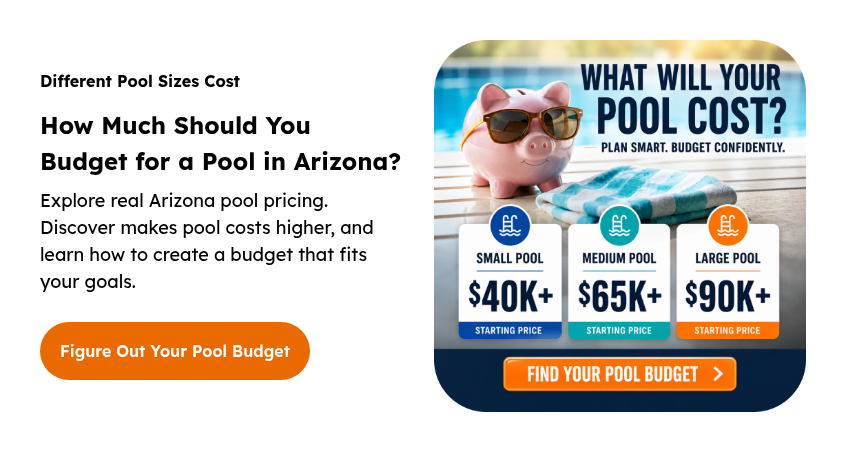
For concrete pools (also called shotcrete), the shell typically commands the highest price tag. These pools range from $45,000 to $100,000, and the shell demands extensive materials and specialized labor. Particularly excavation, framing, and shell installation claim the largest portion of your budget.
Why the shell and excavation dominate the budget?
Shell costs run high because of the engineering requirements. For concrete pools, specialized labor applies shotcrete over carefully positioned rebar frameworks. This process creates a watertight shell that can handle ground pressure and water weight.
Excavation costs can spiral because of equipment requirements and site complexities. Rocky soil or high water tables can tack on $5,000-$15,000. Proper site preparation includes critical elements like drainage systems and soil compaction.
Cross notes, "Don't look at just the pool itself site preparation often hides unexpected costs that other builders might leave out of initial proposals."

How Design Choices Impact Your Final Price
Design choices and equipment selections are the only control a homeowner has over the total pool cost. These decisions can move the final price by tens of thousands of dollars.
Pool shape rarely has anything to do with the overall cost of a pool, unless it's so unique that require unique materials or material cuts, like that of a natural stone to conform to the shape of that "special shape".
The equipment selected for your pool can play a significant role on the initial price of your pool, up or down, and COMPLETELY determines your cost of ownership range, long after the pool company is gone out of your yard.
This is the part that can be the hardest to understand, especially if the company you are meeting with is not walking you through all of your options and is choosing the equipment for you; and believe us, the choice isn't just "salt-chlorine or chlorine tablets". These are the items that are in the pool shell and/or at the pool equipment area that are never seen in the pretty picture. In fact, you can have two pools side by side that look identical, even hold the exact same amount of water, and yet be thousands of dollars apart in price. Empower yourself here. Make the pool company you're choosing not just settle with telling you "cartridge filter", make them tell you the brand and size so you can compare and do your research for what is best for you and your family. Don't let the pool company just say "variable speed pump", have them show you the brand and the size (ie - is it a 1.5 horse power variable speed pump or is it, what used to be the industry standard before inflation, a 3 horse power pump?). This is such a large, permanent investment, you deserve to be empowered with the knowledge and the choice of the equipment that your pool is built with.
As Thomas Cross explains:
“If you didn’t do travertine and went with concrete and a lace acrylic finish so it stays cool, that’s one of the first places I’d look to save.”

Material upgrades: pavers, tile, and finishes
Standard white plaster remains the cheapest option and lasts 5-7 years. Colored plaster adds visual interest but bumps up the cost.
Aggregate finishes combine plaster with quartz, pebbles, or glass beads. They cost more upfront but last 12-20 years. Your premium options break down like this:
- Polished aggregate: Tiny crushed colored stones create a decorative look
- Exposed aggregate: River pebbles or glass beads add texture
- Glass tile: Most expensive but, with light effects, really catch the eye
Decking decisions matter too. As one pool expert puts it: "If you didn't do travertine and you did concrete with lace acrylic over the top so it stays cool, that's one of the first places I would look to save."
What Role does Access, Excavation Equipment, and Site Conditions Play in Pool Project Costs?
One of the larger and least expected costs is backyard access, in other words, how big of a tractor can we get into your backyard. The smaller the equipment the more time labor costs increase.
As Thomas Cross explains:
“Just the size of access could take you from being in the upper 40s for your pool to being nearly into the low 50s, just because of the access size.”
Full-size excavation equipment provides the most efficient and cost-effective option. It typically requires 8–10 feet of clear access. As access narrows, the construction costs increase and so does the time to dig your pool.

How limited access increases excavation costs?
When standard excavation equipment can't squeeze through your side yard, contractors need smaller machines. Those compact alternatives move less dirt per scoop. That $3,500+ premium stings because the finished pool looks exactly the same in photos.
Site-specific challenges like slopes or trees
Sloped yards create challenges beyond just digging the hole. Retaining walls might become necessary, and more of your pool shell ends up exposed above ground. This requires extra structural engineering and materials. Both can add thousands to your budget.
Rocky soil will cost you too. While regular soil runs $2.50-$15 per cubic yard to excavate, rocky conditions jump to $50-$200 per cubic yard. Tree removal in tight spaces costs 25-50% more than standard rates, especially near power lines or structures.
The Real Cost of Building a Pool
Site preparation and structural construction consistently account for nearly half of a pool’s total cost. These costs are regardless of how simple or elaborate the design.
You don't value proper engineering until your pool shifts or cracks from Arizona's expansive soil. As you compare different quotes, check the construction methods used. When one builder is cheaper, you want to ask why.
At Shasta Pools, transparency is how we perform every aspect of the process. You understand where every dollar goes. So, we build the pool you want the right way.
Key Takeaways
-
Excavation and shell construction consume 45-55% of your total pool cost
-
Limited yard access can add $3,500+ to costs
-
Small design upgrades accumulate quickly
- The equipment chosen can play a significant role in initial price and totally in cost of ownership - you should be involved in those choices, ask for details
FAQs
Q1. What is typically the most expensive part of installing an inground pool? The most expensive part of installing an inground pool is usually the excavation, the shotcrete shell and it's engineering and site preparation.
Q2. How much does an average inground pool cost? On average, according to public permit records, inground pools in Arizona generally cost between $45,000 and $75,000 (still the lowest average state in the country).
Q3. Are automatic pool covers worth the investment? They can significantly reduce maintenance, water evaporation and loss of heat. However, they can add $15,000-$20,000 to the overall pool cost.
Q4. How can I reduce the cost of building a pool without compromising quality? Consider opting for more standard material selections or more basic equipment; with basic equipment, you just need to be prepared for more maintenance and, potentially, a higher cost of ownership (electrical, chemical costs, professional pool care, etc).
References
Gulfbreezepoolsandspas.com Does the shape of a pool affect cost?
Rcspoolspa.com How to design a luxury pool
Topics:
