

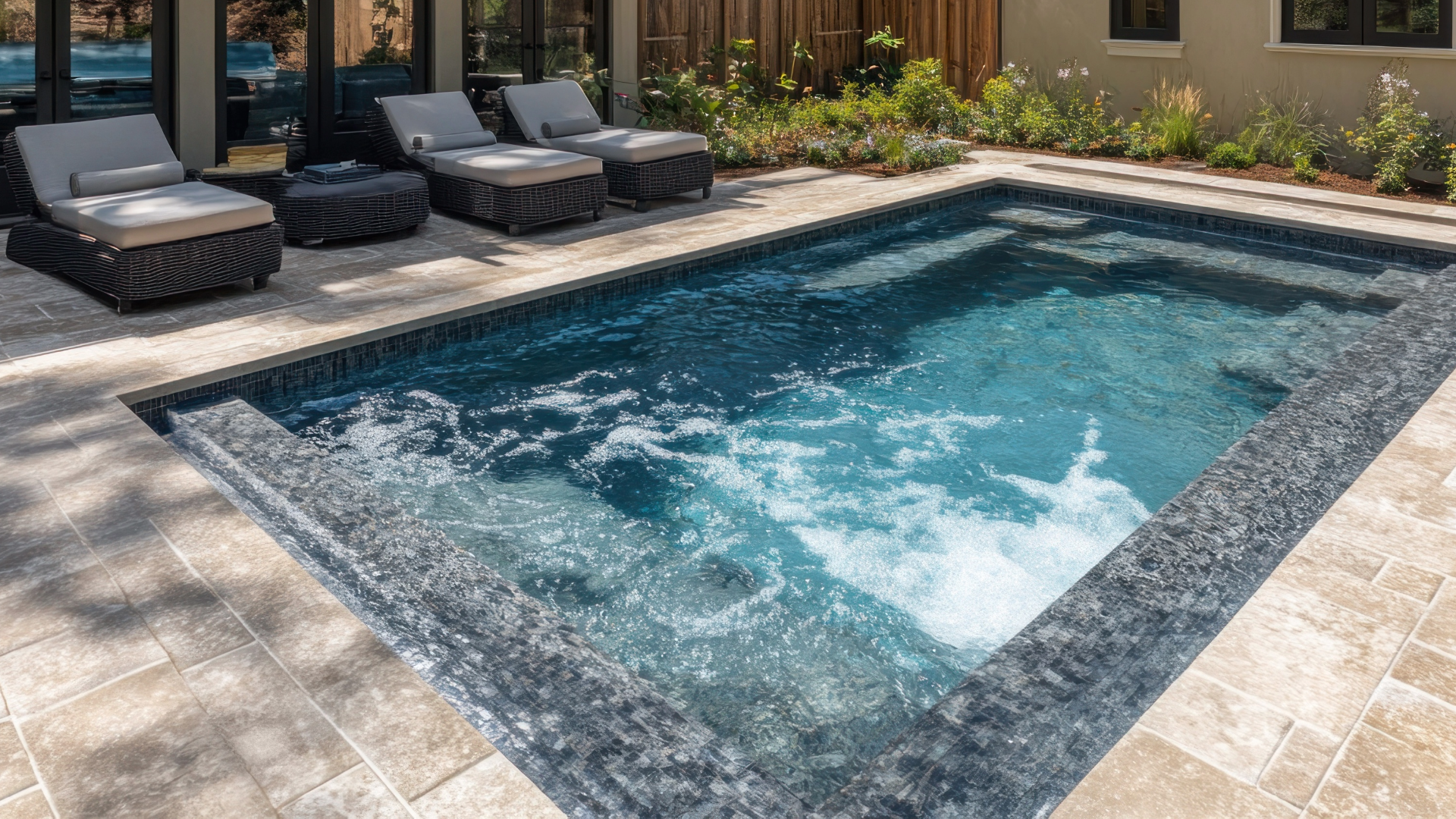
You're looking at your backyard and wondering if there is enough space for a pool?
You might have read somewhere that pools can be as small as 6 by 6 feet. Although, technically true if you're only thinking about drain requirements. However, this isn't the best way to design a pool.
Most newer homes come with backyards between 18 and 35 feet deep. This much space opens up several possibilities for pool design. Understanding your true constraints makes the difference between a pool that fits your space.
After 60 years and more than 100,000 pools, we've learned how to make almost any backyard work. This article shares what are the minimum space requirements and the design considerations that matter most in smaller yards. Plus, showcase how to avoid the common mistakes that turn pool projects into regrets.
Table of Contents
- What is the Minimum Backyard Size Requirements for Installing a Pool?
- What are the Design Considerations for Small Backyard Pools?
- Turning Your Space into the Right Pool
What is the Minimum Backyard Size Requirements for Installing a Pool?
The baseline number you need to remember is 1,200 square feet. That's the minimum yard size that gives you enough room for both the pool and the required clearances around it.
Most builders follow the 25% to 33% rule. Your pool shouldn't take up more than one-third of your total backyard space. Basically, you need room for setbacks and space to enjoy your yard.
A maximum pool size of 12 by 24 feet leaves you space for the mandatory setbacks. A pool can be 8 feet from property lines and 10 feet from your house. Although, each city has their own local codes. Don't forget to plan for outdoor furniture, landscaping, and walking areas.
1,200 square foot baseline
“When people ask how much space they need, I always tell them it’s not just about fitting a pool. It’s about fitting a lifestyle. Once you account for setbacks, walkways, and usable space around it, that 1,200 square foot baseline starts to make a lot more sense. Otherwise, you end up with a pool that technically fits, but doesn’t feel good to live with.” - Jordan Isaac, Shasta Pools Designer
What Small Pool Options Work Best?
The smallest pools we build measure 10 by 16 feet or 10 by 20 feet. These cocktail pools take up less than 200 square feet and usually run 3 to 5 feet deep. They're perfect for cooling off and relaxing.
Spools measure around 20 to 22.5 feet long and 10 feet wide. These create a place to exercise and a spot to unwind with jets.
Plunge pools offer another compact solution at roughly 10 by 16 feet with about 4 feet of depth. They're designed for quick cooling and light exercise.
For families with kids, the standard play pool works well. It features a 75-foot perimeter and typically 28 feet long by 14 feet wide. Therefore, they give children room to play games and keep the footprint manageable.
10 by 16 or 10 by 20 pool
“When you’re working with a smaller backyard, the goal shifts from how big we can go to how well can it function. A 10 by 16 or 10 by 20 pool might sound small on paper. However, the right designed gives you everything you want. They work for cooling off, relaxing, and a place to gather.” - Jordan Isaac, Shasta Pools Designer
What are the Design Considerations for Small Backyard Pools?
Shotcrete pools give you the most flexibility in smaller yards. We can custom size them to fit any dimension your lot allows. Specifically, shotcrete lets us add steel reinforcement exactly where it's needed for structural support. Basically, we can build walls close to existing retaining structures and adjust dimensions to work around awkward lot configurations.
Fiberglass pools face real limitations in tight spaces. There's something called the angle of repose. The steepest angle at which soil can be piled before it starts to slide. Foundations and pools get too close to each other, they interfere with each other's angle of repose. This creates dangerous lateral soil loads. The rule we follow: horizontal distance between your pool and foundation should equal or exceed the difference in their elevations.
Depth planning gets tricky in compact pools. Say you want 5 feet of depth and that requires careful slope calculations. Your drain sits 5 feet off the back wall and entry steps eat up more space. Now, suddenly achieving the depth you want means working within very tight measurements. Miss those calculations, and you end up with a pool that doesn't function the way you planned.
Shotcrete Offers Flexibility
“In tight backyards, the type of pool you choose matters just as much as the size. Shotcrete gives us the flexibility to work around real-world obstacles—slopes, retaining walls, awkward lot lines—because we can reinforce and shape it exactly to the space. With fiberglass, you’re working with a fixed shell, and when space gets tight, that’s where problems can start.” - Jordan Isaac, Shasta Pool Designer

Turning Your Space into the Right Pool
So yes, even smaller backyards can accommodate pools. The difference between a pool that feels cramped and one that feels perfect comes down to planning depth carefully. Get this wrong, and you'll end up with a pool that doesn't fit or one that takes over your entire yard.
Our 60 years of experience can make a difference. We've learned how to look at a challenging backyard and see possibilities instead of problems. We know which construction methods work best in tight spaces and how to maximize your usable space.
At Shasta Pools, we start every project with a free consultation at your home. We explain what's realistic for your lot and show you exactly how a pool could fit into your lifestyle.

References
Lathampool.com Inground Pools for Small Backyards
