

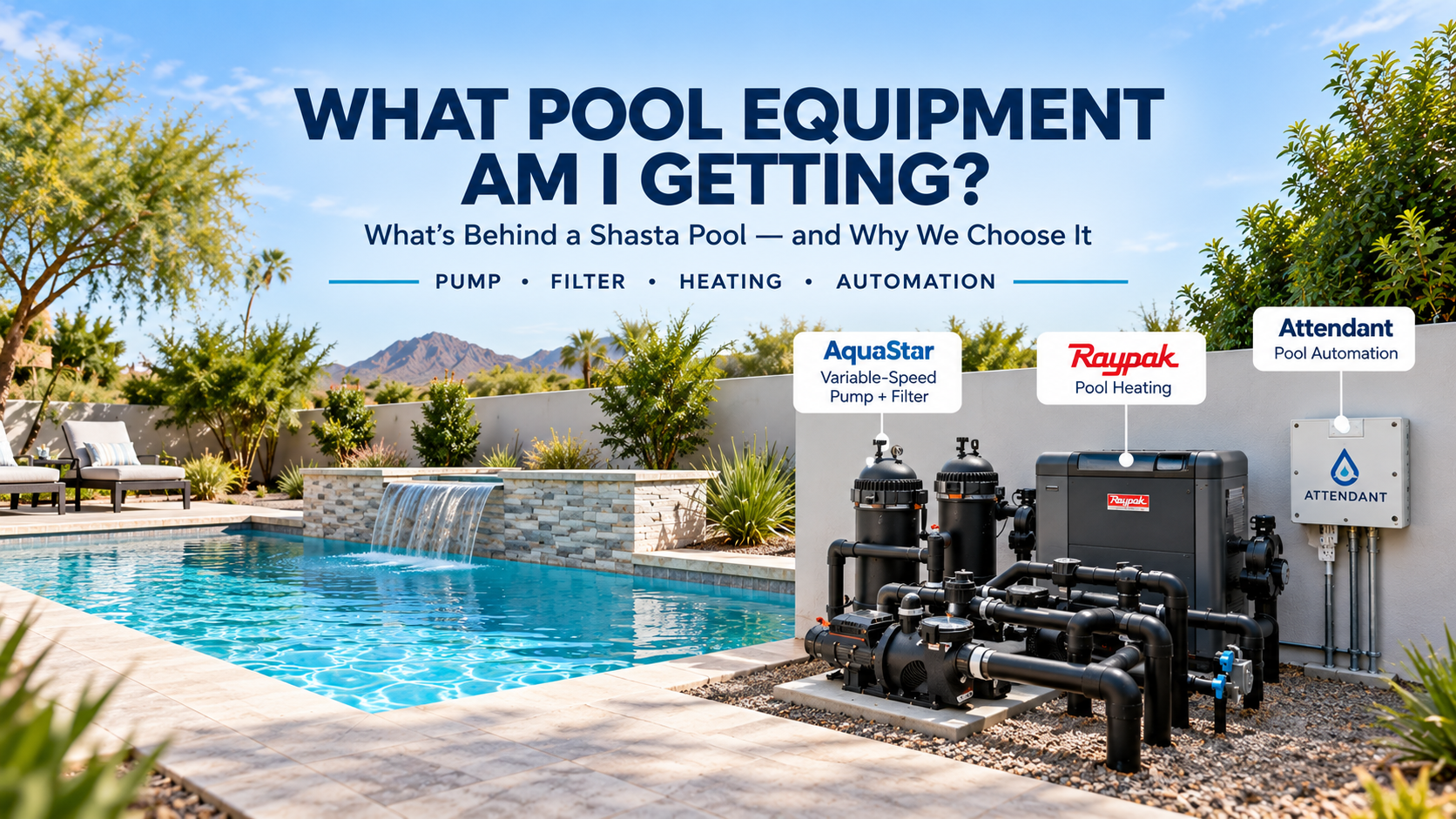
Did you just get a couple bids to build a new pool? Each bid has different pool equipment on it. How do know the differences between what I am getting?
Shasta has been building pools since 1966. In that time, we have constantly updated and improved the equipment we select for new pool construction. We answer the question of why we pick what we do.
This article highlights the pool equipment you find on a Shasta pool. We share the technical differences that we believe make a difference in your backyard. We want you to feel confident that your pool is going to be well run and clean.
Table of Contents
- What pump and filter come standard on a Shasta pool?
- Do I need a heater, and which type is right for my pool?
- What does the Attendant automation system do?
- Bringing It Back to Your Backyard
What pump and filter come standard on a Shasta pool?
Every new Shasta pool comes standard with the Aquastar PLP300S variable speed pump and the Aquastar PLF35000 filter.
A pump that meets Arizona's Title 44 requirement with greater efficiency specs.
Also, a filter designed to clear water faster than older cartridge filters.
Why did Shasta choose the Aquastar PLP300S pump?
The PLP300S is a variable speed pump with a permanent magnet motor. It offers four programmable speed settings ranging from 800 to 3,400 RPM. Next, the pump delivers a WEF (Weighted Energy Factor) rating of 6.5 kgal/kWh. That efficiency rating showcases the differences in ability to move water through your pool system.
-
A higher WEF rating means more gallons filtered per kilowatt-hour
-
The permanent magnet motor allows the pump to run efficiently at low speeds
-
Four programmable speeds let the pump match its output to what the pool needs
What is the Aquastar PLF35000 filter and how is it different from a standard cartridge filter?
The PLF35000 is built to pass a turbidity test in a single pass through the filter. Most standard cartridge filters need multiple passes. That means Shasta can install a physically smaller filter and still get cleaner water than older cartridge systems. (Checkout the PLF35000 specs at Aquastar)
Why the size difference matters:
-
A smaller filter footprint on the equipment pad
-
Water clarity that improves faster after a chemical shock or heavy pool use
-
Built to work specifically with the PLP300S pump's flow rate
Smaller filter, faster results
"On our new Aquastar filters, the water only has to pass through the filter one time to pass this turbidity test... I can confidently tell a client that, listen, you have a smaller filter now than we used to use, and clean your water six times faster." — Eric Matalski, Sales
AquaStar PLP300S Pump
|
Spec |
Value |
|---|---|
|
Motor |
3.0 HP Permanent Magnet Motor (PMM), Totally Enclosed Fan-Cooled (TEFC) |
|
Speed Range |
800–3,400 RPM, 4 programmable speeds |
|
Connections |
2.5" and 2" union connections |
|
Automation |
Integrated RS485 port + WiFi (Smart model); compatible with most major automation systems |
|
Certification |
NSF Certified |
|
Country of Origin |
Made in the USA |
AquaStar PLF35000 Filter
|
Spec |
Value |
|---|---|
|
Filtration Area |
265 sq ft |
|
Filtration Technology |
360° pipeline filtration — water filters from all directions around the cartridge |
|
Turbidity Performance |
Passes NSF turbidity reduction test in 1 turnover; standard cartridge filters typically need up to 5 |
|
Max Flow Rate |
200 GPM |
|
Residential Turnover (12 hr) |
144,000 gallons |
|
Max Working Pressure |
50 PSI |
|
Cartridges Required |
1 |
|
Backwashing |
Not required (cartridge-based) |
|
Certification |
NSF Certified |

Do I need a heater, and which type is right for my pool?
Not every Shasta pool gets a heater. Most homeowners who plan to use their pool more than five months a year need one. The bigger decision is whether a gas heater or the Raypak Crosswind heat pump is the right fit. (Data from Raypak's technical information)
-
How many months a year you want to swim
-
Whether you have a spa that needs to heat up fast
-
How cold your mornings get in the winter
Heating and Swimming in Arizona Winter
"If you want to heat your pool November, December, January, February, and you want to keep it at 88 degrees with a gas heater you would be over $1,200 dollars a month to do it. With a heat pump you're probably closer to $245 to $300 a month." — Gary Dudley, Designer
What's the difference between a gas heater and the Raypak Crosswind heat pump?
When the daytime temperature doesn't get up to 55 degrees, it's not gonna heat your swimming pool. Phoenix only has like maybe five or six days a year, maybe 10 at the very most, where the daytime temperature doesn't reach 50, 55 degrees.
If you just want to swim in those five months, then you don't need a heat pump.
Why do pool/spa combos often get a gas heater?
A heat pump takes two to four hours to bring a spa up to 102 degrees. A gas heater does it in about 30 minutes. This is why most pool/spa combinations still end up with gas.
A heat pump is built for sustained and slower heating. Some homeowners run both. They use a heat pump for the pool and a gas heater dedicated to the spa.

What does the Attendant automation system do?
The Attendant is the automation panel Shasta puts on every new pool. It's built to control equipment from any manufacturer instead of locking you into one brand's ecosystem. That's a shift from how pool automation worked for years. (Data collected from Poolside Tech specs)
What does the Attendant do?
-
Runs your pump, heater, lights, and water leveler on a schedule
-
Adjusts run times automatically based on energy rates and weather
-
Monitors equipment and water chemistry and flags issues
-
Controls everything from a 6-inch touchscreen on the pad or the app on your phone
Built to work across brands, not around one
"Adaptability is probably the best feature out of it too. Just because again, a lot of panel systems in the past have been built for one type of manufacturer... Whereas the Attendant can really be the most versatile and adapt to pretty much any technology." — Noah Edgerton, Sales
Why did Shasta move away from single-brand control panels?
Older automation panels were built to control one manufacturer's equipment. Which meant your control panel decided which pump or heater you were allowed to use. The Attendant allows Shasta to install the Aquastar pump and a Raypak heater.
Poolside Tech's own team has said the product exists because it used to be nearly impossible for a builder or homeowner to mix and match equipment brands.
What can you control or schedule with the Attendant?
Everything on your equipment pad runs through one app or touchscreen. No more separate apps or panels for the pump and lights.
-
Heater and spa temperature scheduling
-
Pump run times, automatically shifted to off-peak electricity hours
-
Lighting schedules and scenes
-
Automatic water leveling and chemistry monitoring
-
Remote access from your phone, plus integration with Amazon Alexa, Control4, and ELAN

Bringing It Back to Your Backyard
The equipment section of you pool bids don't have to match line for line for you. The pump and filter run every single day for the life of your pool. The heater decides how many months a year you get to swim. Also, the automation system makes all of it easy to live with. Getting those choices right up front saves you from finding out the hard way.
If you're still deciding what equipment is best for your pool? The question worth asking isn't which one is cheaper. It's what am I missing, and what is this other company giving me that I need to uncover?
If you're starting to plan a new pool, Shasta's design team can walk you through exactly what's on the equipment pad and why. So, you know what you're getting before you ever sign anything.
Topics:
