

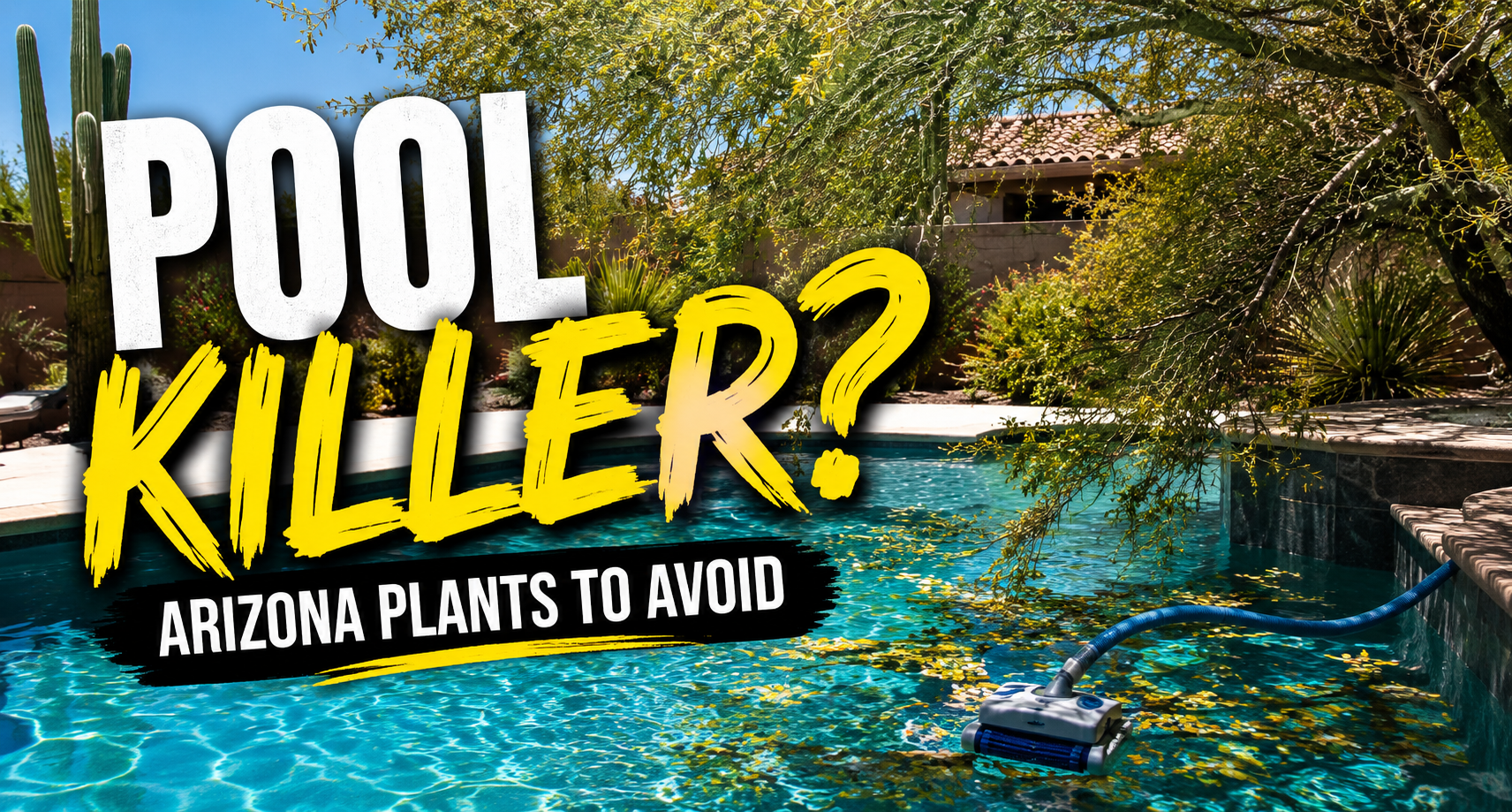
You finally got your pool design approved. Now, you're thinking about the plants that go around it. Maybe you're at a nursery right now, second-guessing the bougainvillea you've always loved. Is your neighbor's pool constantly dirty and wonder if the mesquite tree is the issue?
The plants you choose around your pool will either make ownership easier or make it a lot more work. Some of Arizona's most popular landscape plants are the worst things you can put near a pool. Because of what they do to your water and your equipment.
Shasta has been designing Arizona backyards since 1966. Our landscape team advice below comes directly from Bruce Shipp. Bruce is one of our landscape experts, and how it helps every customer get the most out of the pool landscaping.
Table of Contents
- What Arizona Plants Should You Never Put Near a Pool?
- Why Does It Matter So Much Which Plants You Put Near a Pool?
- Does Bougainvillea Cause Pool Problems in Arizona?
- What Trees Have Roots That Can Crack a Pool?
- The Plants You Choose Today Determine How Much Work Your Pool Is Tomorrow
What Arizona Plants Should You Never Put Near a Pool?
Some plants look great in a Phoenix backyard but create constant headaches. The debris gets into your water and clogs your filter. These plants can throw off your chemistry, and in some cases the roots can find your pool shell.
Avoid Bougainvillea
"I try to avoid bougainvillea. That's the one that everybody loves the color of. But it's probably the worst mess a pool if it's going to have a flower. Like we talked about the bougainvilleas I would avoid, they're heavy in debris. And then some of the desert plants can be a little bit troublesome around a pool. Like if you've got thorns, if you're playing ball, things like that. It can be kind of annoying for kids." — Bruce Shipp, Landscape Expert, Shasta Pools
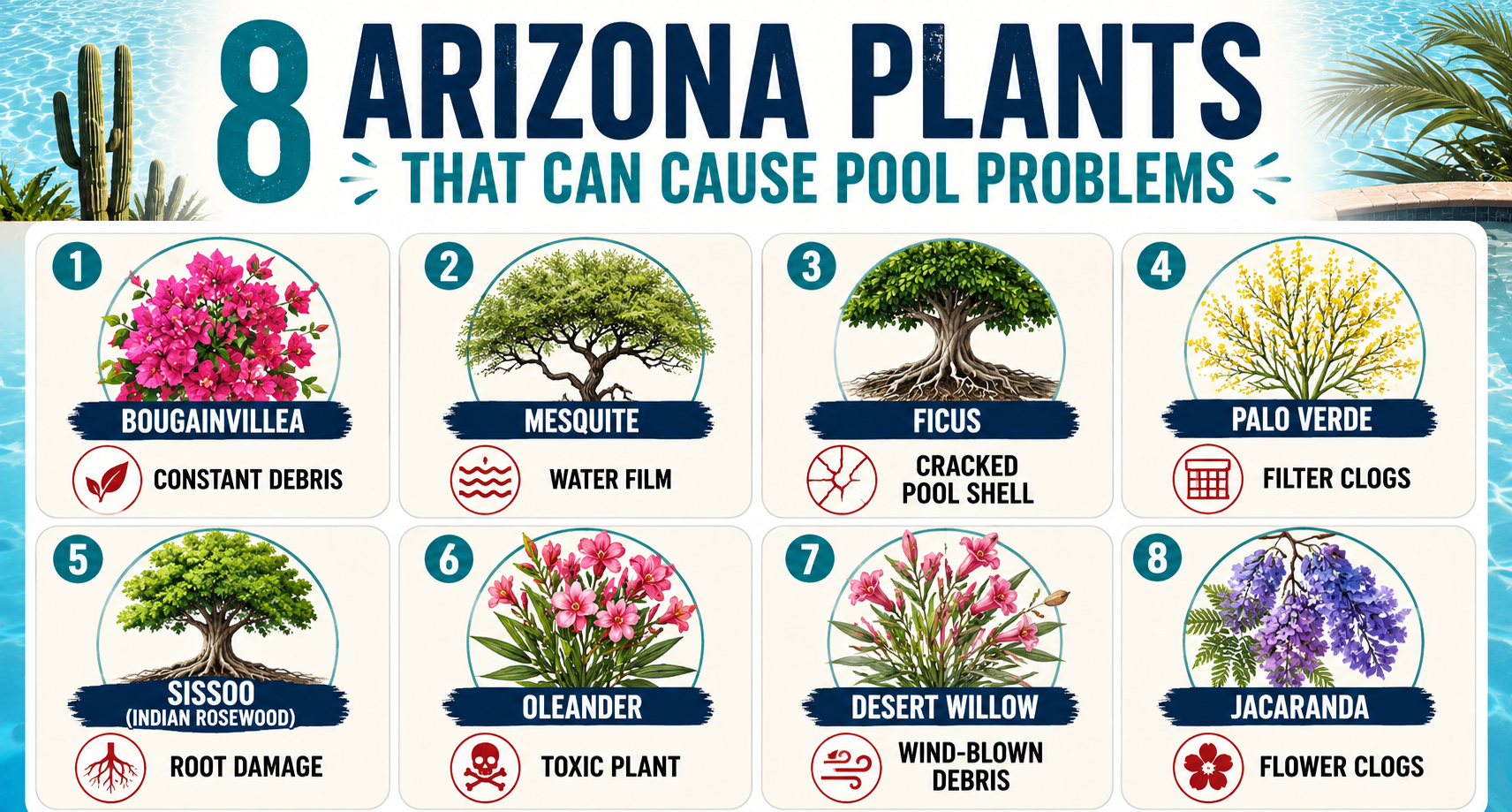
The plants homeowners should avoid near an Arizona pool:
-
Bougainvillea — lightweight papery bracts catch wind and land in the pool constantly
-
Mesquite tree — drops fine leaf litter that leaves a film across the water surface
-
Ficus tree — aggressive roots that travel 30+ feet and can crack your pool shell
-
Palo verde tree — the tiny yellow blossoms during March through May are small enough to bypass most skimmer baskets and clog filtration systems
-
Sissoo tree (Indian rosewood) — one of the most aggressive root systems and should not be in the same yard as a pool regardless of distance
-
Oleander — every part of the plant is toxic and debris falling into the pool area is a safety risk
-
Desert willow — seed pods and lightweight flowers become airborne debris during monsoon season
-
Jacaranda — purple flowers drop in and clog filters fast during bloom season

Why Does It Matter So Much Which Plants You Put Near a Pool?
Every plant near your pool eventually ends up in it. Leaves, flowers, seed pods, and pollen find their way into the water. In Arizona, a few specific plants cause more problems than they are worth.
Plants to Avoid
-
Debris plants that clog your filter and keep your pool looking dirty
-
Root damage plants that go looking for water underground and find your pool shell and your plumbing lines
Crack the Pool Foundations
"They can be searching for water. If they don't have their drip system just completely tuned in, they run the course of least resistance and if they can't find water, they'll push through. If they know it's there, it'll run to it and crack the foundations. It can lift up their sprinkler system and just do a whole lot of damage to their swimming pool." — Bruce Shipp, Landscape Expert, Shasta Pools

Does Bougainvillea Cause Pool Problems in Arizona?
Yes, Bougainvillea is probably the most common pool landscaping mistake.
Why the Bracts Are Worse Than Regular Leaves?
Most people assume leaves are the main debris problem near a pool. With bougainvillea it is the bracts. The papery, petal-like structures that give bougainvillea its color. A regular leaf is heavy enough to float on the surface where you can skim it out. Bougainvillea bracts drift across the yard and can sit on the pool floor.
In Phoenix, bougainvillea blooms heavily March through May and again in fall. Add monsoon season wind between June and September and the bracts travel even further into the pool.
-
Bracts are lighter than standard leaves and harder to catch with a skimmer
-
They stain pool surfaces if allowed to settle on the floor
-
Bloom windows in Phoenix mean debris is heaviest March through May and again in fall
-
Monsoon winds between June and September push bracts further and faster into the water

What Trees Have Roots That Can Crack a Pool?
You cannot undo a cracked pool shell or a plumbing line that has been pushed apart underground. In Arizona, two trees that cause the most problems are ficus and sissoo.
Roots Search for Water
"They can be searching for water. If they don't have their drip system just completely tuned in, they run the course of least resistance and if they can't find water, they'll push through. If they know it's there, it'll run to it and crack the foundations. It can lift up their sprinkler system and just do a whole lot of damage to their swimming pool." — Bruce Shipp, Landscape Expert, Shasta Pools
Why Sissoo Trees Are One of the Most Dangerous Plants Near Any Arizona Pool?
Sissoo trees are also one of the most aggressive root systems of any tree planted in the Valley. Unlike ficus, there is no version of a sissoo near a pool that is manageable. The roots are invasive and actively seek water. They have been documented destroying irrigation systems, cracking pool shells, and lifting hardscape.
Sissoo should not be in the same yard as a pool.
-
Sissoo roots are among the most aggressive of any tree planted in the Phoenix metro
-
They actively seek water sources including pool shell and skimmer boxes
-
No safe planting distance exists near a pool

The Plants You Choose Today Determine How Much Work Your Pool Is Tomorrow
Many homeowners do not think about plants and pools together. They pick their landscaping for how it looks. Then the bougainvillea bracts start staining the floor and the mesquite drops a film across the water every morning.
The plants around your pool are maintenance decisions. Get them right before anything goes in the ground and pool ownership is easier. Get them wrong and you are fighting the yard every week. We just try to keep it where it's the stuff that grows more of a manicured shape, you know, keeps to its form and always consider the size at full maturity when you're planting something.
Some people think they need to go with no sprinkler system if they go with a desert landscape around it. We would still tell folks that even then you still need to add a drip system just to give them a start until they're mature enough to be able to handle it on their own and to make sure that everything is just getting watered regularly versus sporadically.
A thirsty plant is a plant with roots looking for water. In an Arizona backyard, the pool is usually the closest source.
If you are planning landscaping around a new or existing pool and want to get it right the first time, Shasta's Landscape team can help you design a backyard that works as one complete outdoor living space.

Resources
- Watershapes.com — Ficus Trees and Pool Damage (Scott Cohen, Chairman, California Pool and Spa Association)
https://watershapes.com/lessons-learned-root-awakenings-ficus-trees-and-pool-damage/
- University of Arizona Cooperative Extension — Mesquite and Palo Verde Trees for the Urban Landscape
https://extension.arizona.edu/publication/mesquite-and-palo-verde-trees-urban-landscape
- ASPCA Poison Control — Oleander Toxicity
https://www.aspca.org/pet-care/aspca-poison-control/toxic-and-non-toxic-plants/oleander - ASPCA — Flowers and Plants Toxic to Pets
https://www.aspca.org/news/do-you-know-which-flowers-and-plants-are-toxic-pets-our-experts-explain
