

After more than 60 years of building pools in Arizona, we find the best pool for your money isn’t always the cheapest.
In 2025, Pool & Spa News named Shasta Pools one of the Top 50 Builders in the United States, ranking us #4 nationally. This recognition reflects our commitment to building pools that create the most value for customers.
Yes, we sell pools. However, we don’t believe in selling just the most expensive option. We believe in building the right pool. The best swimming pool for the money must prioritize quality construction, efficient equipment, and practical features.
A high-quality pool-only installation typically falls between $50,000–$70,000. Additionally, pool-and-spa combinations generally ranges from $70,000–$90,000. These are just ranges. Within each dollar value lies the best option to maximize the pool you get.
This guide shows the pool designs and construction practices that offer the best long-term value.
Table of Contents
What is the Best In-ground Pool Setup for the Money?
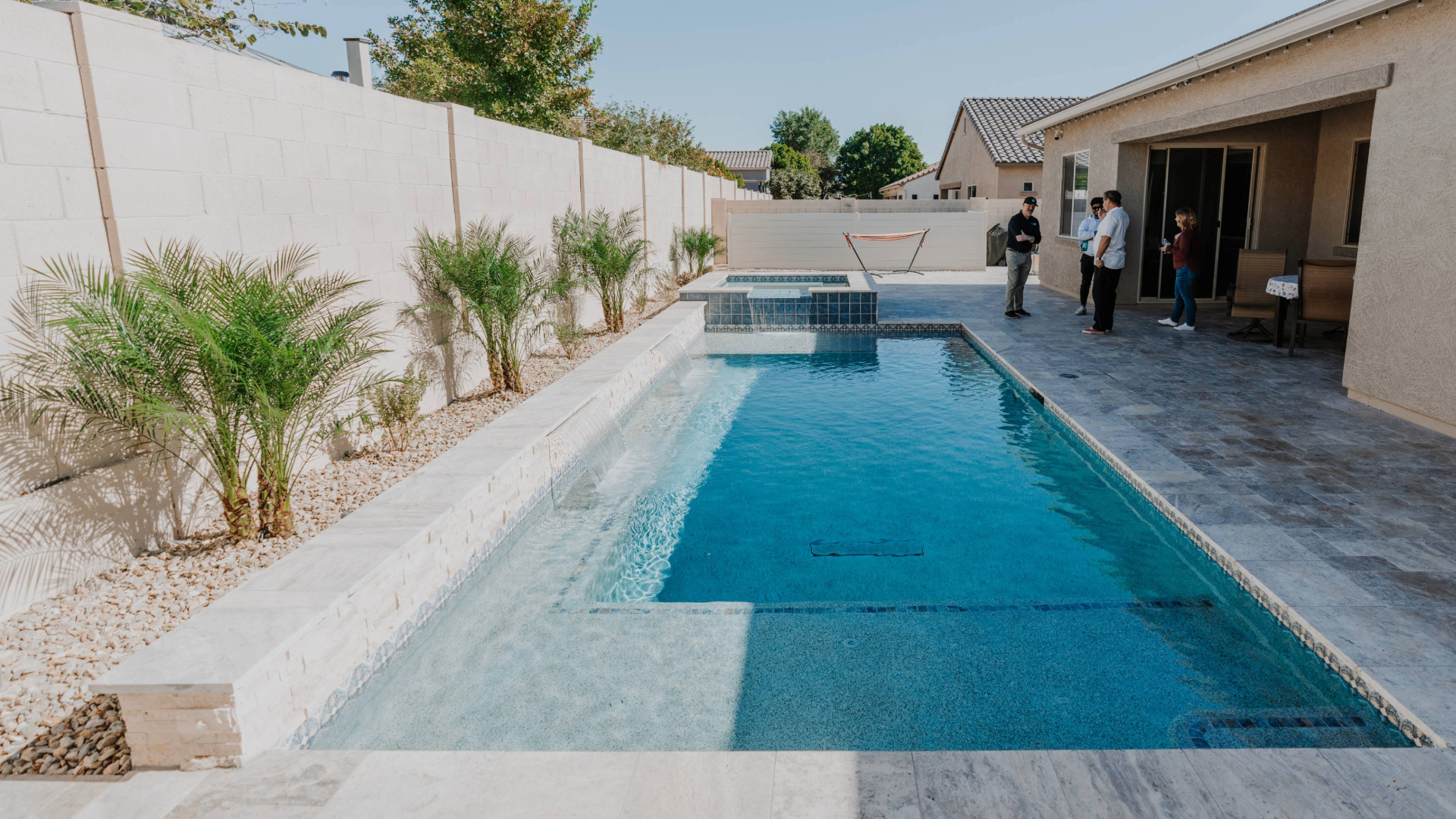
The best in-ground pool setup for the money is a 15’x30 rectangular pool. Furthermore, adding energy efficient equipment and in-floor cleaning complete the best long-term value.
Investing in Durability and Efficiency
After designing more than 450 pools, Shasta designer Thomas Cross consistently sees homeowners overspend on aesthetic upgrades. He says “People say yes to $1,000 here and $2,000 there, and by the end, they’re $10,000–$20,000 over budget.” The key is investing in engineering that improves durability, efficiency, and daily enjoyment.
-
Functional 15’x30 rectangular design instead of complex curves
-
Concrete decking with lace acrylic coating instead of higher-cost stone pavers
-
In-floor cleaning with a high-efficiency system that reduces chemical use
-
Energy-efficient equipment that protects your utility bills

How Does Pool Size and Shape Create Real Value?
The right pool size and shape should reflect your family's pool activities. For most Arizona homeowners, a simple 15’ x 30’ rectangular pool delivers the best balance of versatility and long-term cost control. It provides room for swimming, games, and relaxing. Complex curves may increase excavation, structural, coping, and decking costs. For many homeowners, these complexities don't add any meaningful functionality.
As Shasta designer Thomas Cross notes, many homeowners add features that look great on paper but rarely get used. For example, water features that run only “half a dozen times in the last year.” Focusing on durability, efficiency, and usability creates a pool that serves your family for decades.
-
A simple rectangular layout for maximum functionality per dollar
-
Concrete decking with lace acrylic coating instead of higher-cost stone pavers
-
Carefully evaluated features (waterfalls and upgrades only if you’ll truly use them)
-
Awareness of yard access costs, which can add $1,500–$3,500 to excavation
.png?width=1920&height=1080&name=valuepool%20(1).png)
How Does Quality Pool Engineering and Site Prep Create Greater Value?
Quality engineering and thorough site preparation are the foundation of a pool built to last. These elements are invisible once construction is complete — but they determine whether your pool performs beautifully for decades or develops costly problems within a few years.
At Shasta, we’ve seen the difference firsthand. Two pools may look identical on installation day. The one with proper soil prep, compaction, grading, and structural engineering will age gracefully. The one without it often shows cracks, settling, equipment strain, or drainage issues over time. Cutting corners here doesn’t save money — it simply delays the bill.
Proper engineering and site prep deliver long-term value through:
-
Soil analysis and compaction to prevent shifting, cracking, and structural movement
-
Complete demolition and site preparation included upfront — no surprise excavation charges later
-
Correct grading and drainage planning to protect your pool shell and surrounding hardscape
-
Reduced long-term repair costs from structural stress or equipment damage
-
Improved efficiency when paired with properly sized, energy-efficient equipment
We recently reviewed a competing proposal nearly $30,000 lower than ours — until we discovered almost $5,000 in required demolition and site prep had been left out entirely.
Engineering may not be the most exciting part of a pool build, but it’s the part that protects your investment. Build it right from the start, and your pool becomes an asset — not a future repair project.
|
Ready to Ask the Right Questions? |
|
What Does Your Pool Budget Buy You?
In 2026, a high value pool-only installation typically ranges from $50,000–$70,000. Next, a pool-and-spa combination costs between $70,000–$90,000. Within that range, your best budget invests in long-term performance and durability.
-
Proper structural engineering and full site preparation — no surprise demolition or excavation charges later
-
Energy-efficient, correctly sized equipment built to last 10–15 years, not 5–7
-
Durable interior finishes that maintain their appearance
-
Effective water circulation systems that reduces chemical waste
-
Reliable automation that simplifies ownership
We recently reviewed a proposal nearly $30,000 lower than ours. Only to discover almost $5,000 in essential site prep had been excluded.
Prioritizing usability over flashy extras can create a pool that delivers satisfaction for decades. In many Arizona neighborhoods, simply having a pool can add significant resale value. This value is often independent of cosmetic upgrades.
The right budget doesn’t just buy a pool. It buys confidence that it was built the right way from the start.
How to Design Your Pool for How You'll Actually Use It
The best pool design starts with honesty. Not what looks impressive online. At Shasta, we guide homeowners to design around lifestyle first, aesthetics second. A pool built around real usage delivers far more long-term satisfaction than a “showroom-perfect” design filled with features you rarely turn on.
Eliminate Unnecessary Costs
As Shasta designer Thomas Cross, who has designed more than 450 pools, explains, “I try to always provide examples of how this could be more value engineered.” That means eliminating unnecessary costs and focusing your investment where it actually improves your experience.
Start by asking:
- How many people will use the pool regularly? Size for your real needs — not oversized entertaining scenarios.
- What activities matter most? Exercise, relaxation, family play, or hosting? Shape and depth should reflect that.
- How much maintenance do you want? Simpler designs reduce cleaning time and operating costs.
- What does your yard allow? Limited access can add $1,500–$3,500 in excavation costs.
Smart design decisions can save $10,000–$15,000 or more. Straightforward layouts cost less than elaborate curves, which increase labor, structure, coping, and decking expenses by 10–25%. Concrete decking with lace acrylic coating provides a cooler, safer, and more cost-effective alternative to expensive stone pavers. And as Cross puts it, “If you only want four chaise lounges, don’t pay for space big enough to hold eight.”
Design for how you live — not for how it photographs. That’s how you create a pool that feels right for decades.
|
Want to understand what really drives pool pricing? |
|
What Options on Your Pool Pay You Back?
Some pool upgrades simply look impressive. Others actually reduce your long-term costs. Smart pool owners focus on options that improve efficiency and reduce maintenance over time. The right upgrades may cost more upfront, but they lower lifetime expenses.
Features that typically pay you back include:
-
In-floor cleaning systems improve circulation and reduce chemical use
-
High-efficiency pumps lower monthly energy bills
-
Reliable automation optimizes filtration schedules
-
LED lighting uses less energy
As Shasta designer Thomas Cross explains, “You’re getting better filtration with less time. The actual turnover of the pool is more consistent, and the chemical spread means you need fewer chemicals.”
When comparing lifetime costs, consider the alternatives. Robotic cleaners may cost $1,000–$1,500 upfront but often need replacement every five years. Manual cleaning requires 100+ hours per year of your time. Poor circulation can even contribute to plaster damage — a repair that can exceed $15,000.
Not all “in-floor cleaning” systems are equal. Simply saying you want in-floor is like saying you want a smartphone — the technology matters. Ask your builder which system they use and why.
Quick Reference Guide
|
What You're Deciding |
What This Means |
What It Costs |
Why It Matters |
|
Best Pool for Your Money |
Quality construction over lowest bid |
$50,000-$70,000 (pool only) |
Can add $100,000 to home value |
|
Smart Pool Setup |
Simple rectangular design ~15'x30' |
Limited access adds $3,500 |
Design for how you'll actually use it |
|
Features That Pay Back |
In-floor cleaning systems |
In-floor cleaning: $2,500-$3,500 |
Cuts chemical costs and maintenance time |
|
Smart Places to Save |
Concrete with acrylic coating vs. expensive stone |
Water features: $4,000 + $2,000 pump |
Focus budget on what you'll actually use |
The Shasta Difference in Long-Term Value
After 60 years of building pools in Arizona, we’ve learned that value isn’t measured by the lowest bid. It’s measured by how well a pool performs five and even twenty years from now.
The best in-ground pool for your money focuses on structural integrity and designs. It avoids unnecessary upgrades that inflate the price. It includes complete site preparation, proper engineering, and systems designed for long-term performance in our desert climate.
At Shasta Pools, we do sell pools — but more importantly, we build lasting relationships. Creating the best long-term value creates the best long-term customers. That philosophy has helped us earn national recognition, including ranking #4 in the United States as a 2025 Pool & Spa News Top 50 Builder.
The right pool isn’t about spending more. It’s about spending wisely — so your backyard becomes a source of enjoyment, not regret, for decades to come.
Key Takeaways
- Invest in features that reduce lifetime costs: In-floor cleaning systems ($2,500-$3,500) and energy-efficient equipment pay for themselves
-
Design for your actual usage patterns, not showroom appeal: A simple 15'x30' rectangular pool often provides more value
-
Save strategically on esthetics without compromising function: Choose concrete with lace acrylic over expensive travertine pavers
-
Never compromise on structural engineering and site preparation: These invisible elements prevent costly repairs and ensure your pool investment lasts decades
FAQs
Q1. What is the ideal budget range for a high-quality inground pool? For a pool-only installation, budget between $50,000-$70,000. If you're looking for a pool-spa combination, expect to invest $70,000-$90,000 for optimal value.
Q2. How can I save money on my pool without compromising quality? Focus on functional design over esthetics. Choose simpler shapes, use concrete with lace acrylic coating instead of expensive pavers.
Q3. What pool features offer the best long-term value? Invest in an in-floor cleaning system, energy-efficient equipment, and LED lighting.
Q4. How important is proper site preparation and engineering for a pool? Extremely important. Quality engineering and thorough site prep form the foundation of a durable, long-lasting pool.
Q5. Does an inground pool add value to my home? Yes, an inground pool can add significant value to your property. In certain neighborhoods, homes with pools can command up to $100,000 more than similar properties without pools.
References
Poolspanews.com 2025 Top 50 Builders: This Years's Standouts
Topics:
